


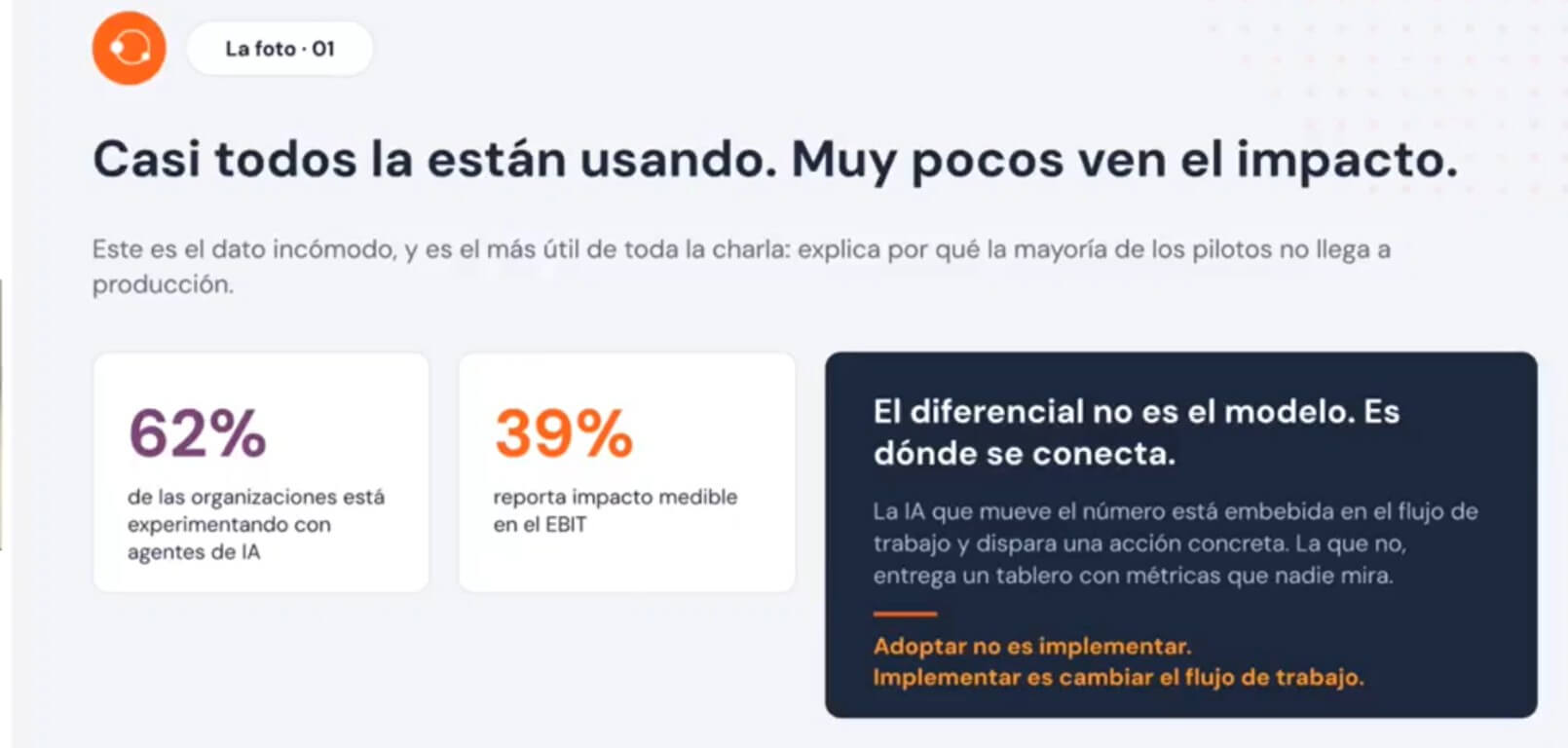
62% of organizations are already experimenting with AI agents, but only 39% see a measurable impact on EBIT. Ariel Bortz (Known Online) concluded the latest episode with that fact webinar from the company, after hearing Rodrigo Arévalo Noriega (ClinicalMarket) explain why a B2B distributor doesn’t sell but rather supplies, and Claudio Rivas Figueroa (Lo Valledor) describe how he tripled his lead qualification rate. The B2B Commerce no longer begins when a salesperson receives a lead. Today, it’s possible to connect the entire sales cycle using technology: identifying prospects, qualifying them, providing quotes, closing the first sale, and fostering repeat business with personalized terms—all without relying on a turnkey model. The goal behind this is not technological; it is business-related: greater control over digital assets, lower operating costs, and faster revenue generation.
What sets apart companies that scale their B2B operations from those that remain at the pilot stage is whether their ERP, CRM, and catalog can answer five specific questions before a customer confirms an order. This is a comprehensive summary of what was presented, including the three real-world case studies behind those numbers.
Key Points About B2B Commerce
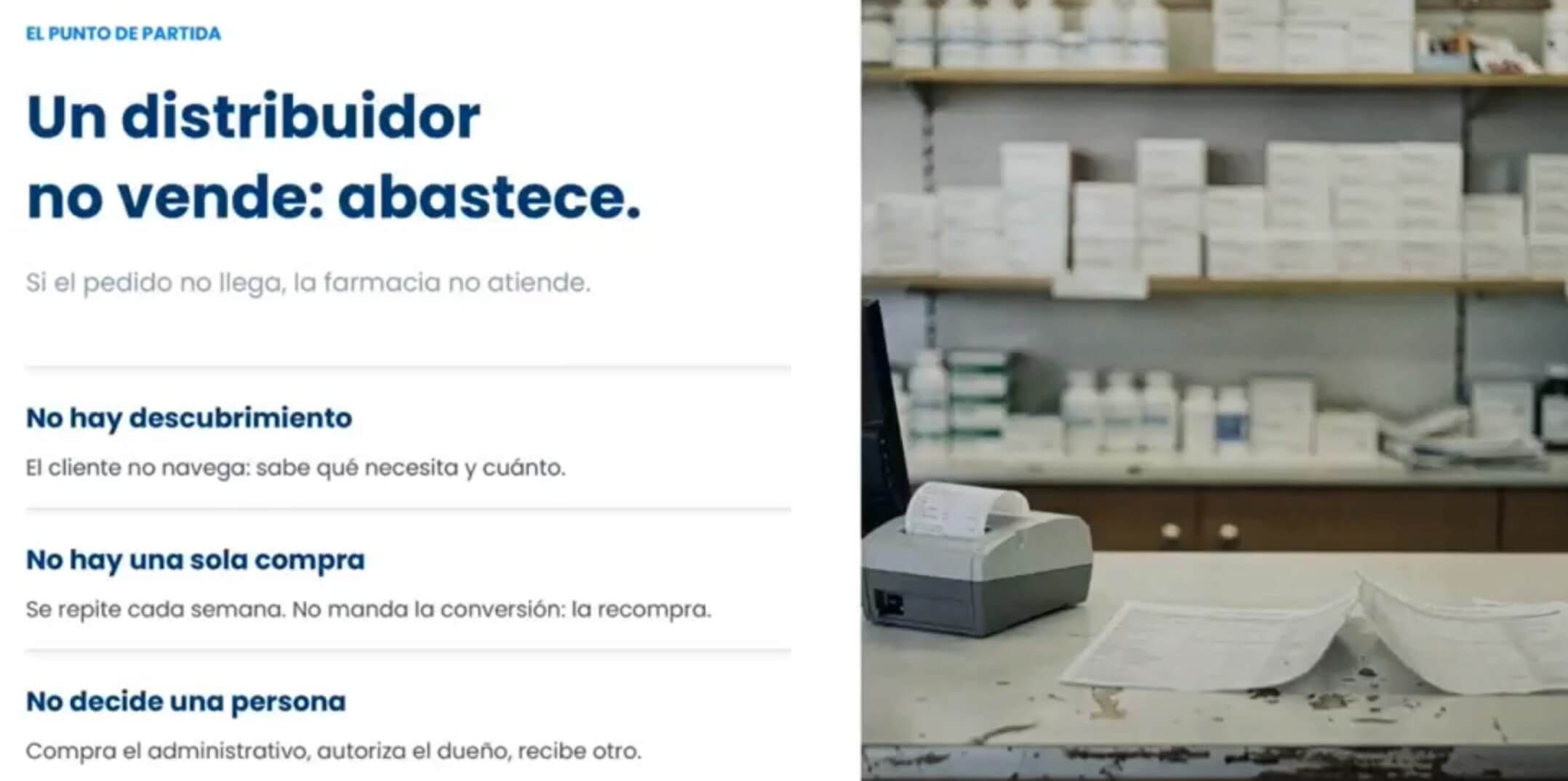
- A B2B commerce distributor doesn’t sell—it supplies: the customer already knows what they need, and the sale involves several people (the buyer, the decision-maker, and the operator), not just one.
- A B2B order does not exist until five questions are answered (identity, price, credit limit, actual inventory, assigned sales representative), and all five depend on the ERP system, not the catalog.
- Lo Valledor increased its B2B lead qualification rate from 20–30% to 70–80% by filtering for tax ID numbers (RUT) associated with active food-related business activities and by leveraging the depth of data prospects provide on the form.
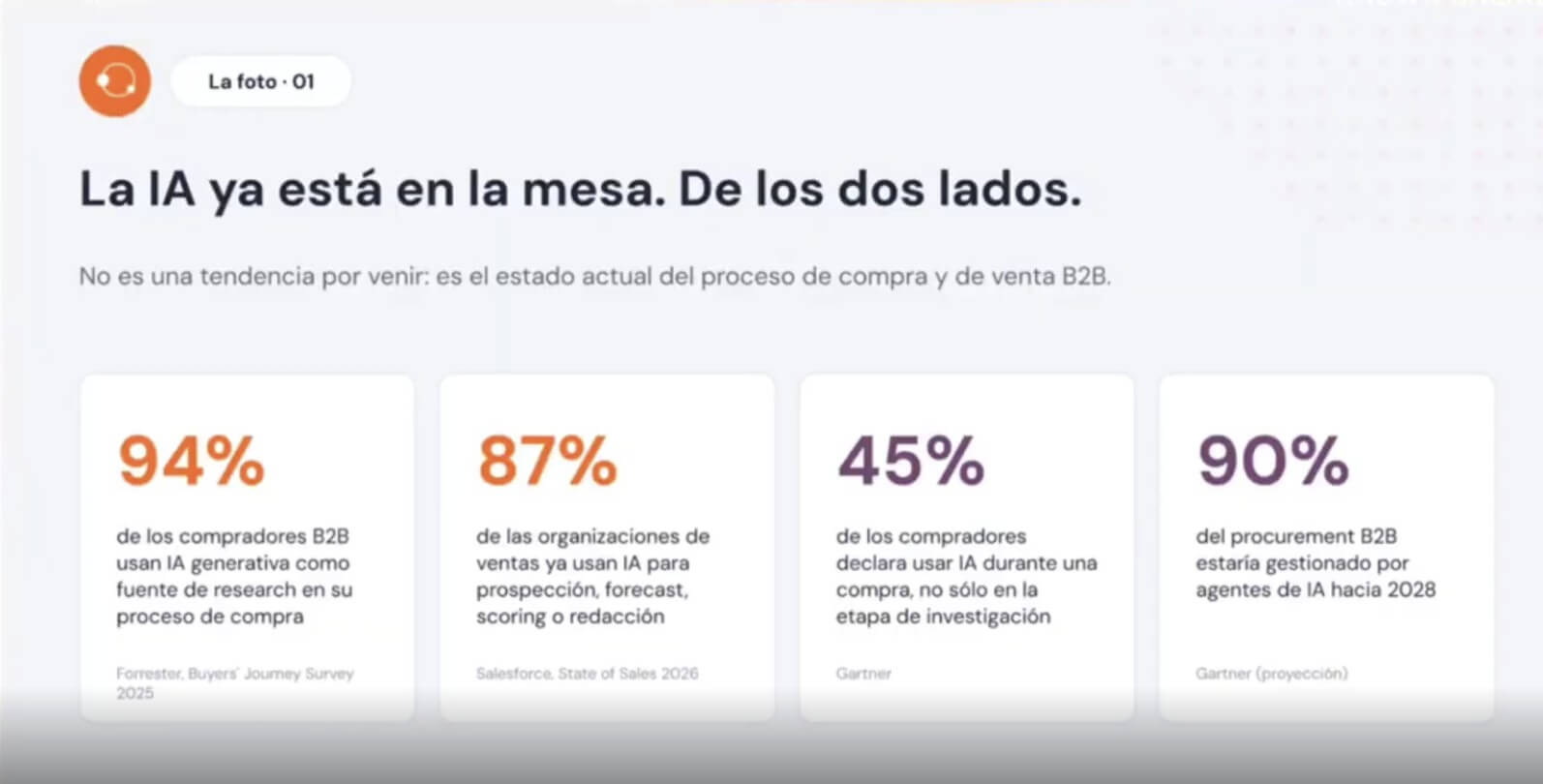
- 94% of B2B buyers already use generative AI as a research tool before making a purchase (Forrester), and 45% use it during the purchase process, not just during the research phase (Gartner).
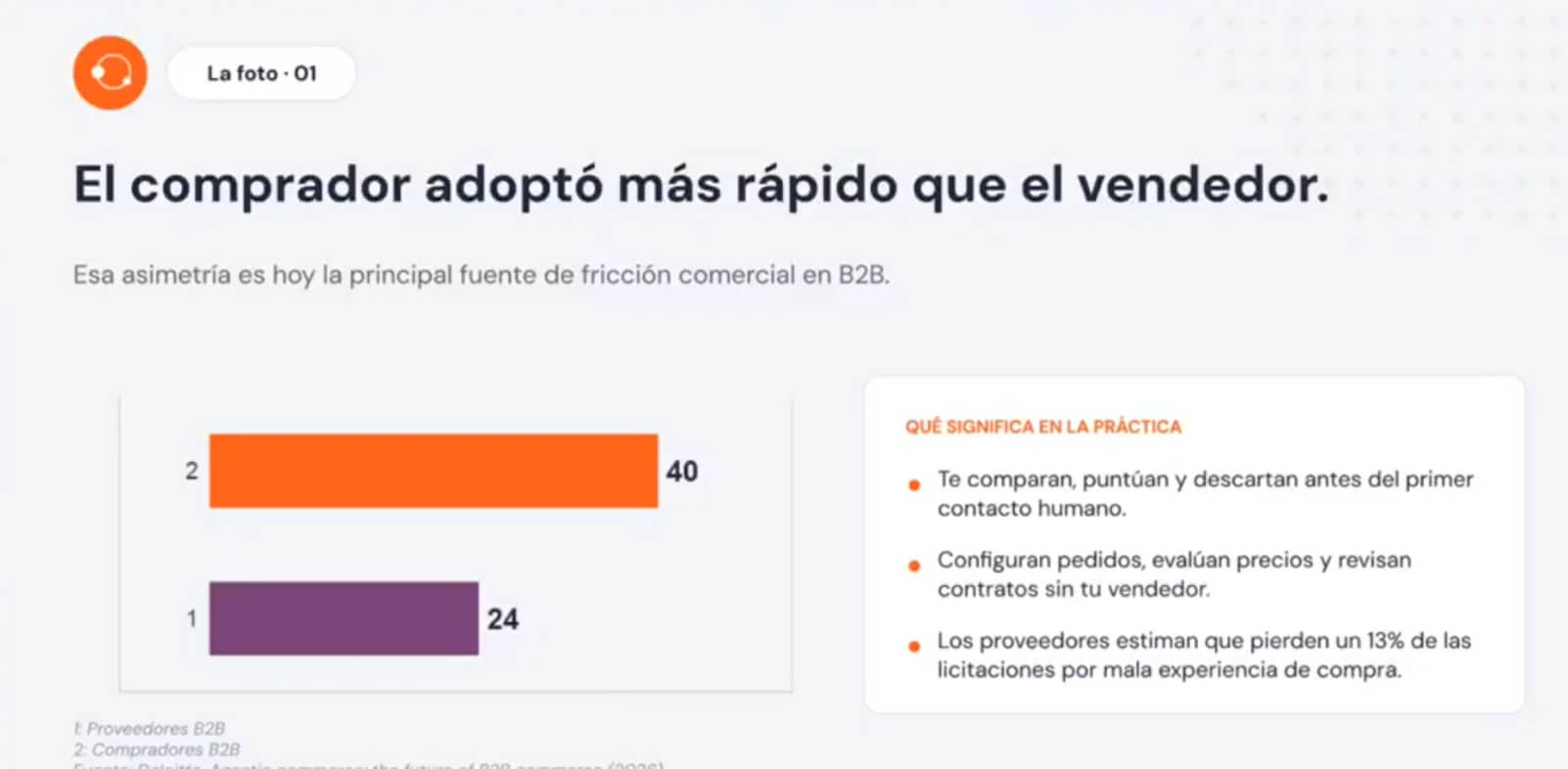
- There is an asymmetry in adoption: 40% of B2B suppliers already use AI, but only 24% of buyers do. That means many buyers compare, rate, and rule you out before the first human contact.
- Sixty-two percent of organizations are experimenting with AI agents, but only 39% see a measurable impact on EBIT (McKinsey): the difference isn’t in the model—it’s in where it’s deployed.
- There are four points in the B2B sales cycle where AI changes a specific metric: prospecting and qualification, conversation and self-service, catalog and content, and sales support.
- 54% of executives report data integration issues between systems and channels: that is the real obstacle to moving from pilot to production, not the AI model.
- A sales rep without access to an account’s actual inventory, price, and sales terms isn’t a sales rep—it’s a chatbot incapable of driving business metrics.
The Misconception: A Distributor Doesn’t Sell—It Supplies
Rodrigo Arévalo heads the digital channels at ClinicalMarket, a pharmaceutical holding company pharmaceutical holding company that includes wholesale distribution, the Profar retail chain for end consumers, and its own laboratories. His starting point was to understand the business before the technology: as a distributor, ClinicalMarket doesn’t just sell—it has to supply—and that changes everything. It cannot stop or fail, because on the other end there are hospitals, clinics, and pharmacies that depend on that supply chain.
The trap, according to Arévalo, is assuming that a B2B commerce platform with more SKUs is a better B2B platform. On the surface, a B2B portal looks the same as a B2C e-commerce site. But beneath the surface, the rules change for every variable:
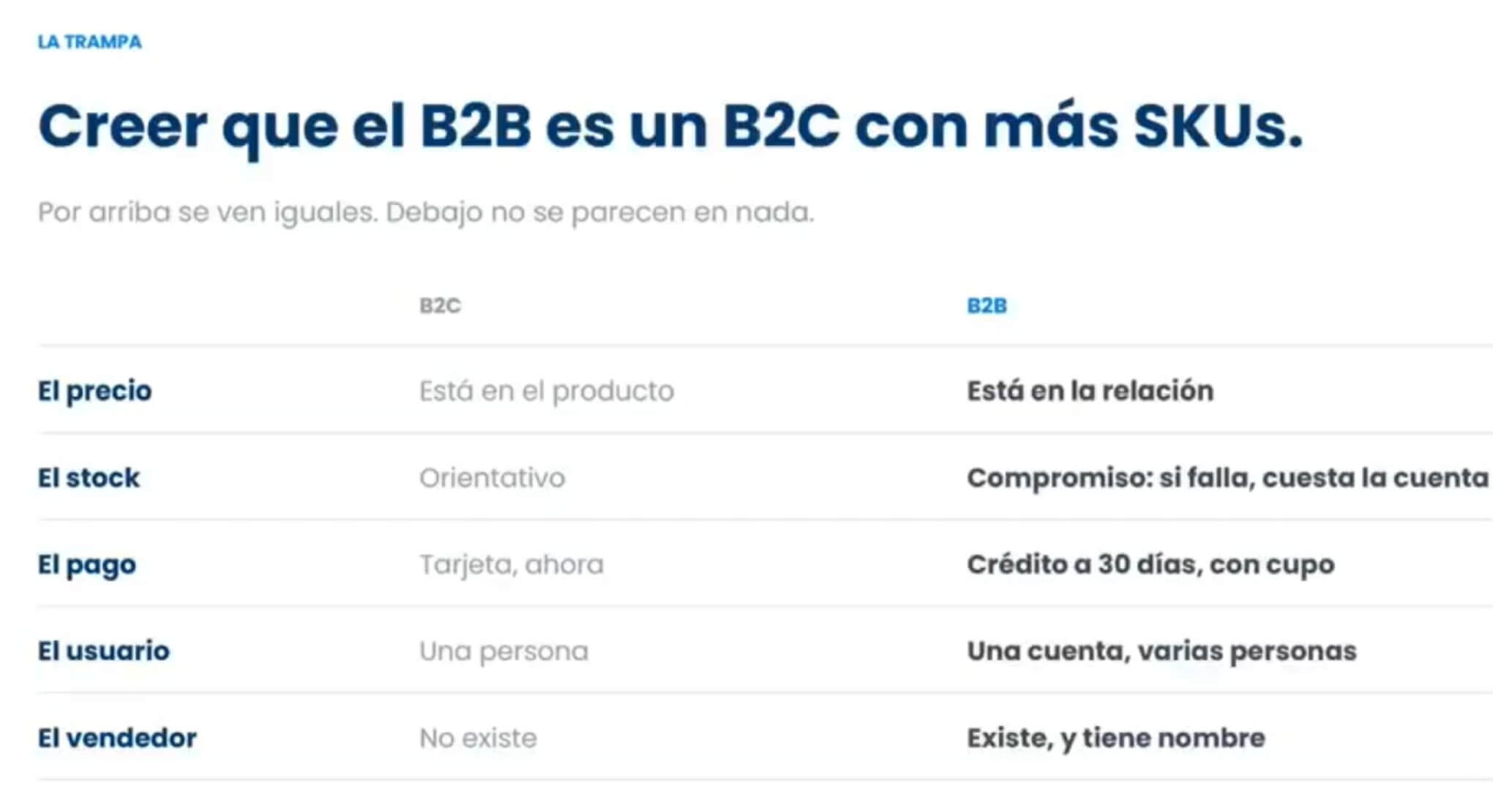
In B2C, the customer discovers what they want. At a distributor like ClinicalMarket, the customer comes in knowing what they need and makes a purchase. The conversation doesn’t end there: every purchase kicks off a repeat-purchase relationship involving a buyer, a decision-maker, and an operational team—three roles that are almost never filled by the same person.
The 5 Questions a B2B Order Must Answer
This logic gave rise to the criteria Arévalo uses to design any B2B workflow: five questions that determine whether an order is legitimate—and which, in his experience, are resolved in the ERP system, not in the catalog.
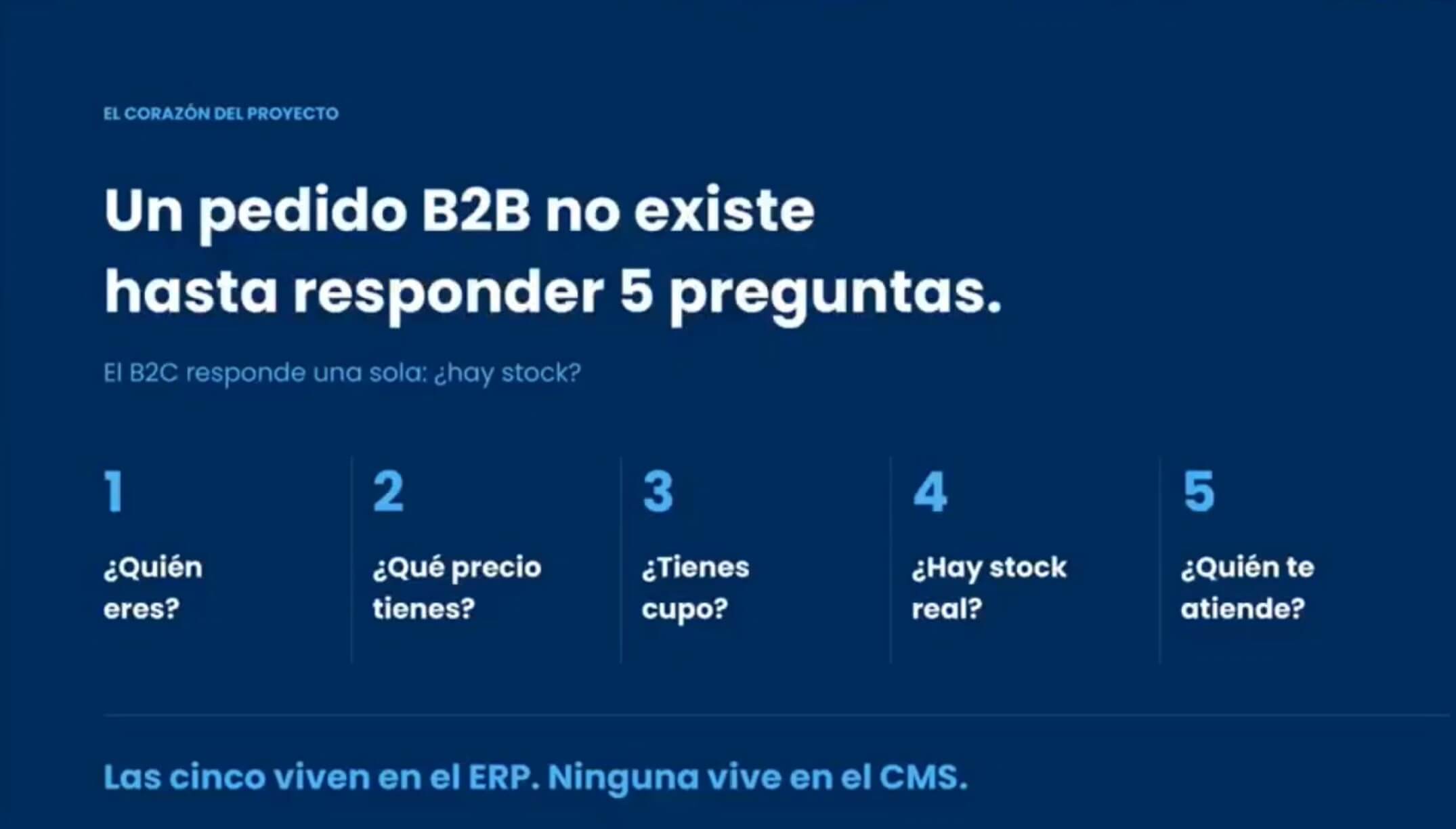
- Who are you? Registration isn’t just a matter of providing an email address and password like in B2C: you must enter your Tax ID (RUT), company name, line of business, tax status, addresses, and business locations. A single account can have multiple users with different needs.
- What are your prices? There is no single-price catalog: ClinicalMarket distributes to hospitals, clinics, and independent pharmacies, and each one negotiates its own price list.
- Do you offer credit terms? Credit with different payment dates gives customers the freedom to stock up and continue selling. The terms vary depending on the type of account.
- Is there actual inventory? This isn’t just an estimate: if the system shows inventory that doesn’t exist, the entire transaction suffers.
- Who is assisting you? The salesperson remains part of the process. The portal doesn’t replace them; it simply eliminates the need for manual order entry.
These five questions are the starting point for the architecture, not the end. If you want to see in detail what distinguishes a scalable B2B portal from one that remains an internal demo, we explore this in “B2B Portal: Why the Problem Is Almost Never the Platform.”
Localization isn’t just translating the site
On that basis, Arévalo emphasized that “localizing” a B2B commerce platform is not a matter of language: it is the multitude of business rules and variables that coexist within the operation. In this case: different tax and billing terms depending on the customer, customers who prefer to pay in cash and others who need credit, active management of collections, debt, and delinquencies, participation in the public market and bidding processes, logistics coverage (for ClinicalMarket, delivering throughout Chile while meeting deadlines), specific sales units, and—since the products are medications—end-to-end traceability and cold chain.
Part of that value proposition is already automated: the invoicing process connects the purchase (ERP or e-commerce) to an RPA system that streamlines picking and packing; a proprietary product called Data Logger certifies that the cold chain was maintained for each shipment; and the shipping logistics use GPS and a multi-fleet operation to optimize routes by area.
How to Qualify a B2B Prospect Without Losing the Human Touch
Claudio Rivas heads up digital marketing at Lo Valledor, a national distributor of meat products that serves the HORECA sector (hotels, restaurants, and food service) and the traditional retail sector (convenience stores and neighborhood grocery stores). His assessment of what changed: it wasn’t just buyer behavior; it was companies’ fear of missing out (FOMO) on the digital channel as they watched the competition make moves.
There is a cross-cutting shift affecting both B2B and B2C commerce: buyers are researching more thoroughly before making a decision, and increasingly relying on generative AI as a guide. This has a direct consequence for any brand: if you don’t have an online presence and indexed content, AI may invent information about your business because it has no real data to draw from.
The filter that tripled the qualification rate
To distinguish a genuine prospect from a casual inquiry, Lo Valledor uses two specific filters:
- Tax ID number (RUT) with an active food business classification. This tax requirement serves as an indicator that the business has already undergone a health inspection and has an approved location, which suggests recurring purchases (weekly, in many cases).
- The depth of the data provided by the prospect. When someone fills out their phone number, name, address, tax ID number, email address, and products of interest on the form, it’s a sign of genuine intent, not mere curiosity.
With that filter in place before prospects reach the form, Lo Valledor went from qualifying between 20% and 30% of its leads a few years ago to qualifying between 70% and 80% today.
What Technology Can’t Replace
Rivas was straightforward about the limits of automation: face-to-face contact—especially for large purchases (in his case, bulk meat orders)—cannot be replaced by any known technology, neither AI nor any other substitute, because there is an element of empathy that AI can only simulate. What should be automated, however, are repetitive and administrative inquiries—such as stock levels , prices, and order status—which can be handled via WhatsApp or the website without depending on a salesperson being available at that moment.
The problem isn’t the technology; it’s the process.
During the discussion between Patricio García De Leo and Claudio Rivas, a common issue emerged that affects most B2B digitization projects: companies often come in asking to lower operating costs and acquire more customers while spending less, but they rarely have a defined digitization process in place before choosing a technology.
Before recommending a tool, at Known Online we identify the specific pain points of traditional operations: customers who aren’t billed, non-recurring customers because they rely on someone to contact them, administrative processes that a system could handle faster than manual checks, and companies that generate a lot of revenue but struggle with collections because that process relies on people rather than systems.
From there, we focused on three key areas: reducing operating costs by streamlining every step of the process (orders, reorders, invoicing, collections, delivery, and responding to inquiries); ensuring a standardized process across the operations, administration, and sales teams, because without that alignment, cultural change driven by technology cannot happen; and prioritizing quick wins at bottlenecks that directly impact revenue, since these projects typically take between 3 and 6 months, and sometimes up to a year and a half.
On how to get sales teams on board rather than creating resistance, Rivas described Lo Valledor’s approach: identify salespeople who act as champion users of the technology, prototype minimalist tools with them that are easy to understand right away, and sustain adoption through constant guidance from the support team. His closing remarks on the direction of the next B2B transformation were concise: AI technology already exists and is advancing faster than the market; the real bottleneck is cleaning and standardizing data before applying any model.
Key Findings on AI Adoption in B2B Commerce
Ariel Bortz, from Known Online, wrapped up the webinar with statistics that explain why most AI projects fail to take off.
According to Forrester,94% of B2B buyers already use generative AI as a source of research before making a purchase, which makes working GEO and AEO positioning no longer optional.
According to Salesforce, 87% of sales organizations already use AI for prospecting, forecasting, scoring, and content creation. And according to Gartner, 45% of buyers say they use AI during the purchasing process, not just during the research phase: what used to be three stages of the sales funnel (discovery, consideration, decision) now tends to be condensed into a single stage, because AI informs, suggests, guides, and ultimately tells buyers where to purchase.
There is one disparity worth noting: 40% of B2B buyers say they are using AI, but only 24% of B2B suppliers actively use it. This gap has a concrete business consequence: buyers compare, rate, and eliminate options before the first human contact; they put together orders and evaluate prices without a salesperson’s knowledge; and suppliers estimate that they lose about 13% of bids due to a poor digital shopping experience.
And here’s the key finding: 62% of organizations are already experimenting with AI agents, but only 39% report a measurable impact on EBIT ( McKinsey). The difference isn’t which model each company chose. It’s where that model was integrated into the daily workflow.
The 4 Areas Where AI Excels in the B2B Sales Cycle
Bortz identified four specific areas of focus, each with a specific business metric to determine whether the project is working or not:
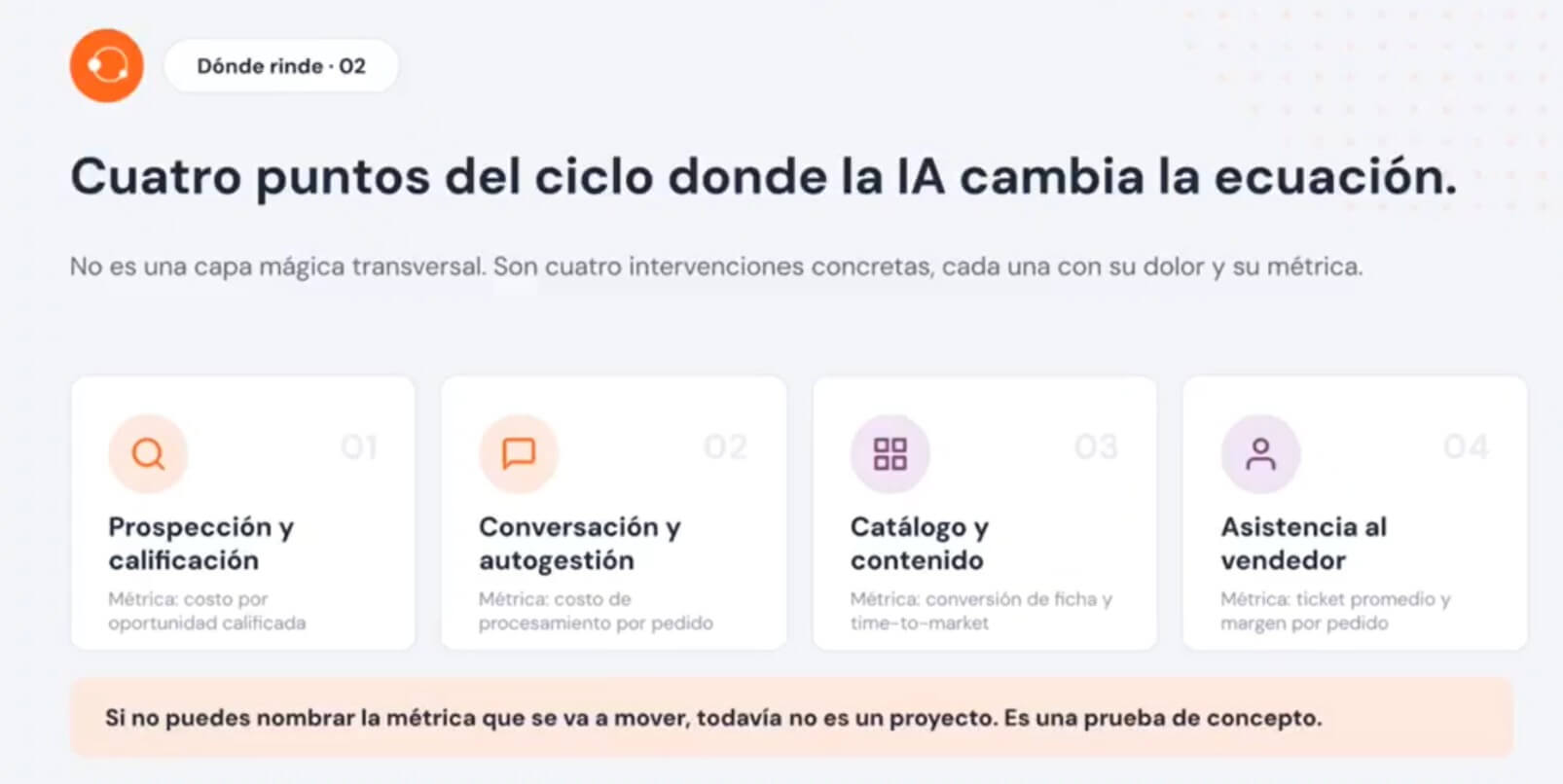
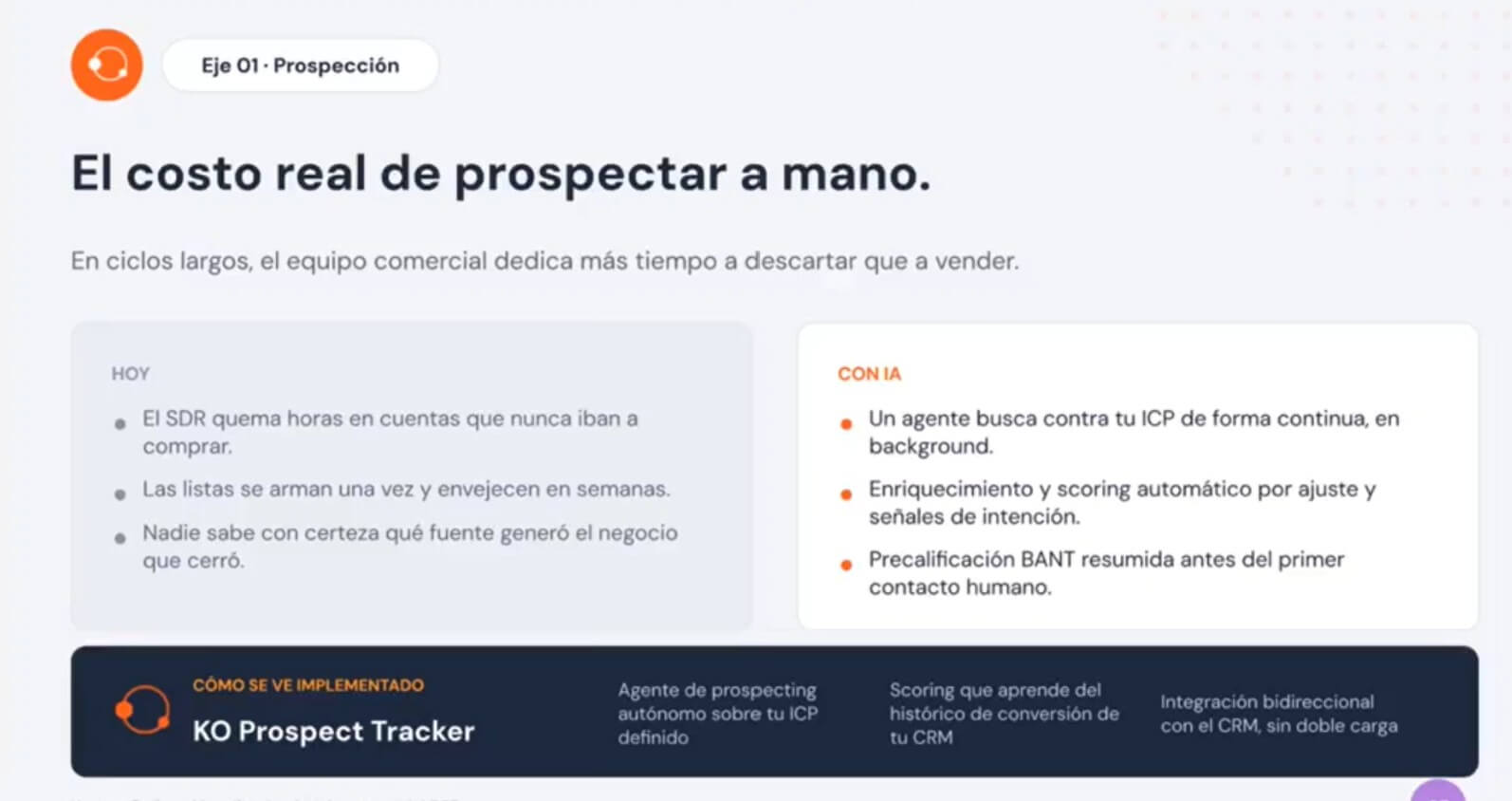
- Prospecting and Qualification (metric: cost per qualified opportunity). The common problem: SDRs contacting accounts that were never going to buy, lists that are compiled once and become outdated within weeks, and no one knows for sure which source closed a deal. The solution that Known Online implements under the name Prospect Tracker is an agent that continuously searches for the ideal customer profile (ICP), applies scoring that learns from conversion history, and integrates bidirectionally with the CRM without double data entry.
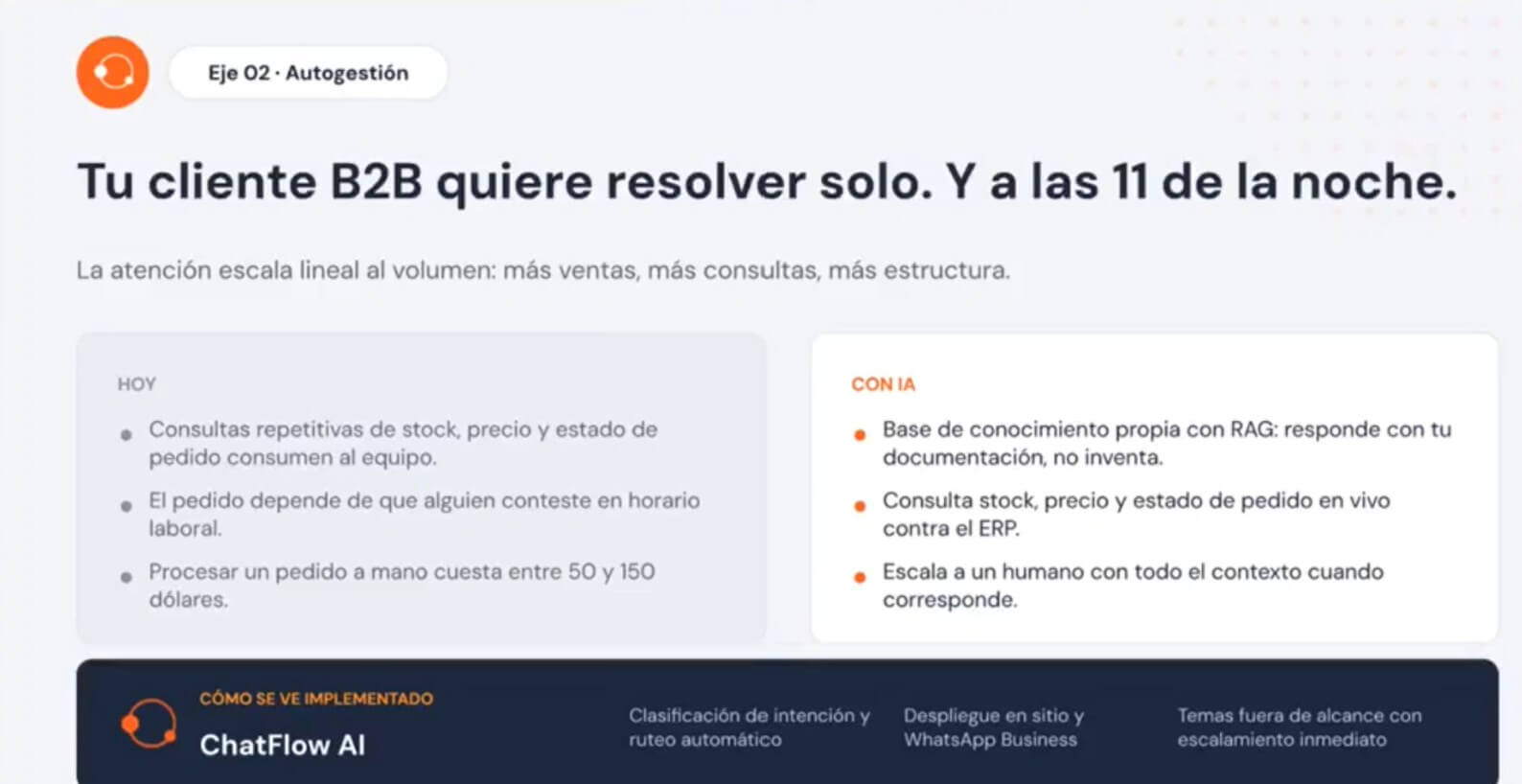
2) Conversation and self-service (metric: processing cost per order). Processing an order manually costs between $50 and $150 in sales rep time—and that’s before even factoring in the cost of acquiring that customer. Known’s solution, ChatFlow, responds with the company’s actual documentation (via RAG, without inventing information), checks inventory, price, and order status directly from the ERP, and escalates to a human only when the context requires it.
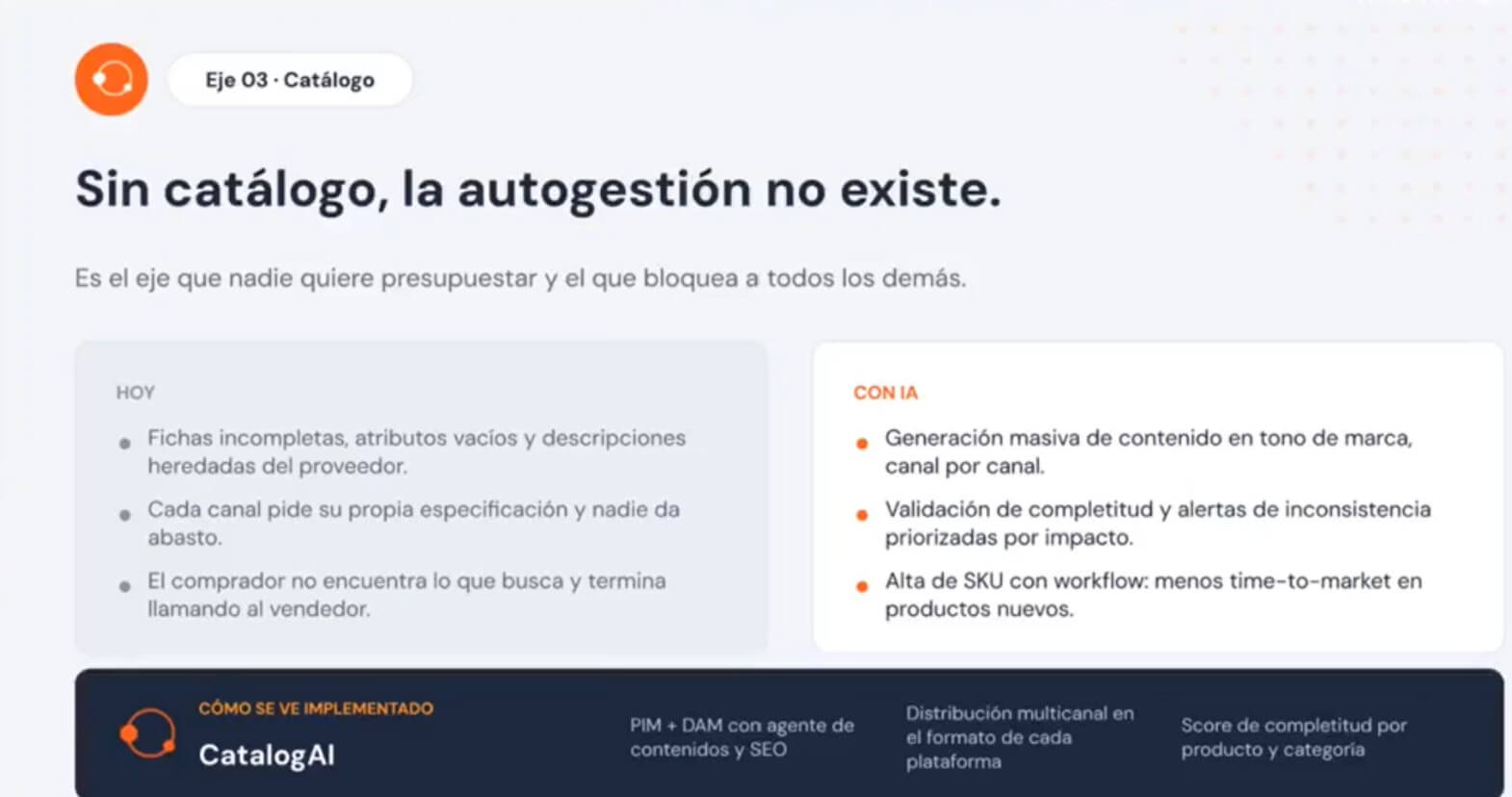
3) Catalog and content (metrics: product listing conversion and time to market). Incomplete product listings, empty attributes, and descriptions inherited from the supplier result in unnecessary inquiries to the seller. CatalogAI, Known’s PIM + DAM with an AI agent specialized in SEO, generates large volumes of brand-aligned content by channel, validates completeness, and prioritizes alerts by impact, reducing the time it takes to list a new SKU.
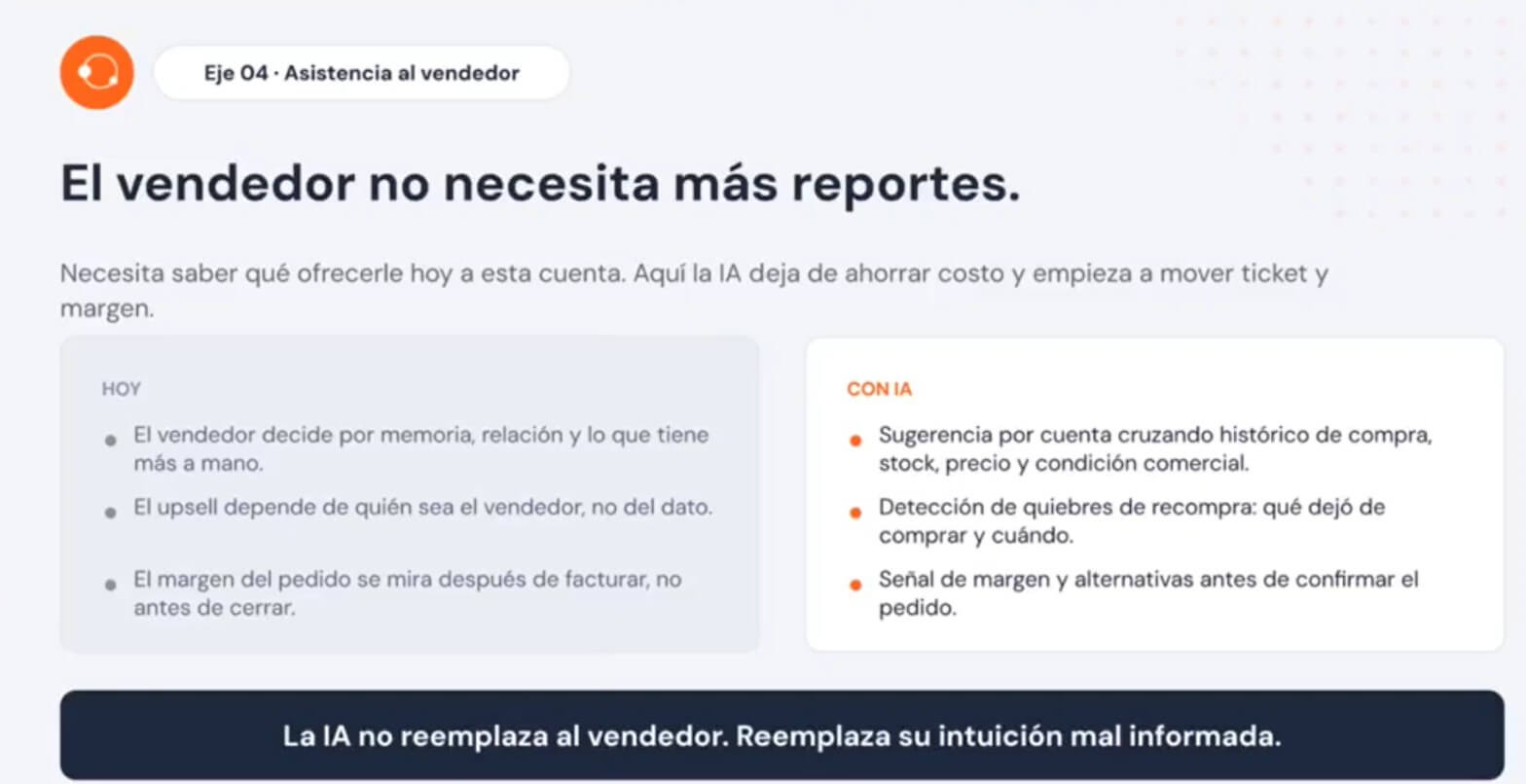
4) Salesperson Support (metrics: average ticket and margin per order). Today, upselling depends on each salesperson’s memory, and the margin is measured after the order is billed, not before. To address this, Known Online is building an assistant that cross-references each account’s purchase history, inventory, price, and commercial status, and suggests what to offer, where there are opportunities for upsells or cross-sells, and what that customer has stopped buying—all before the salesperson confirms the order.
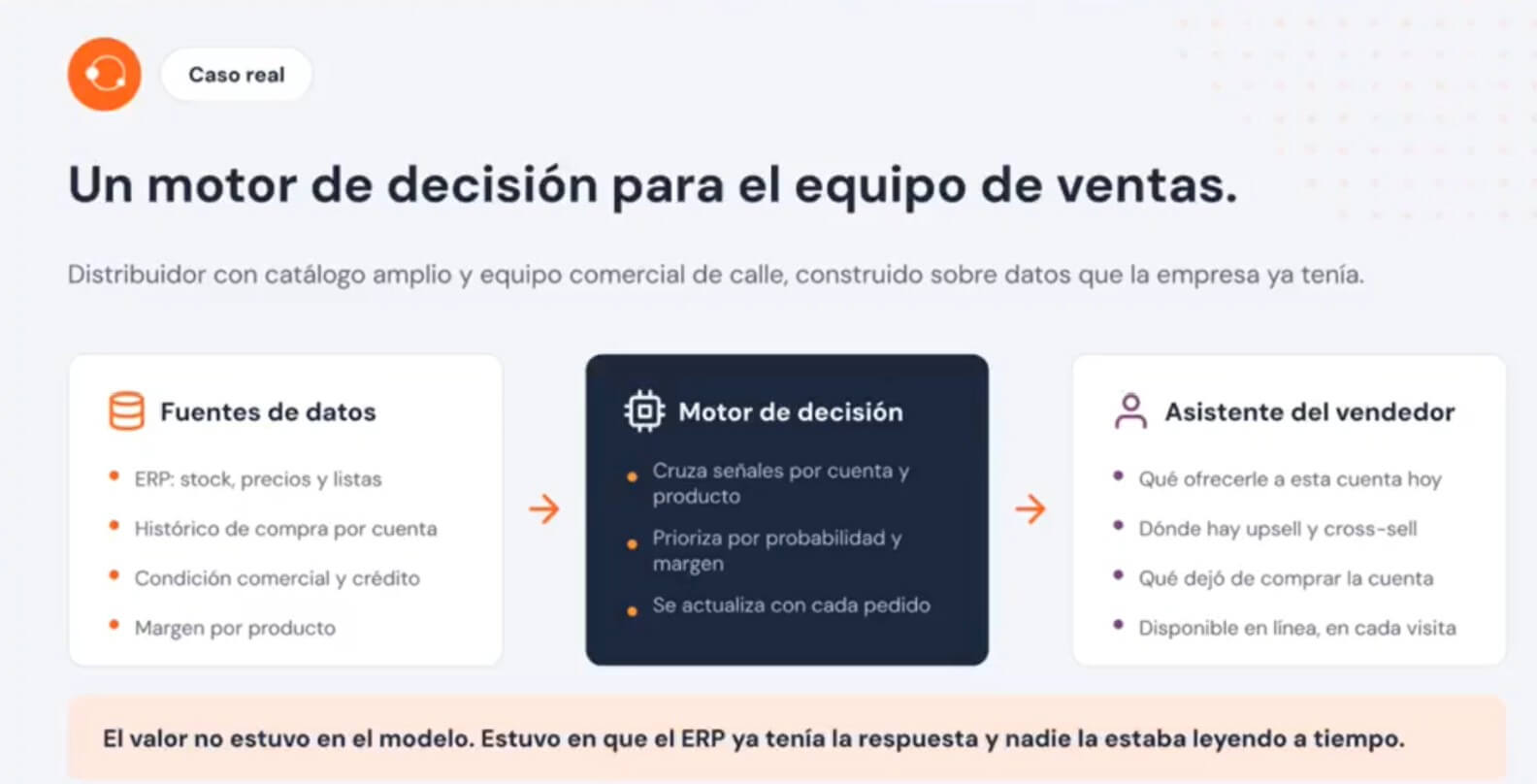
The real : a decision engine built on existing data
Bortz detailed an implementation case: a distributor with an extensive catalog and a field sales team.
The starting point was the data the company already had, with no need for new systems: inventory, prices, customer lists and segments from the ERP API, purchase history by account, commercial terms and credit, and margin by product.
Using that data, a decision engine was built that cross-references signals by account, product, and context, prioritizes by likelihood of purchase and by margin, and updates with every new order. The results are delivered to the salesperson via a simple mobile app: what to offer each account today, where there are upsell or cross-sell opportunities, what the customer has stopped buying, and what’s available at the time of the visit. The value wasn’t in adding new information, but in processing and delivering the information the ERP system already had.
Why Most AI Pilots Never Make It to Production
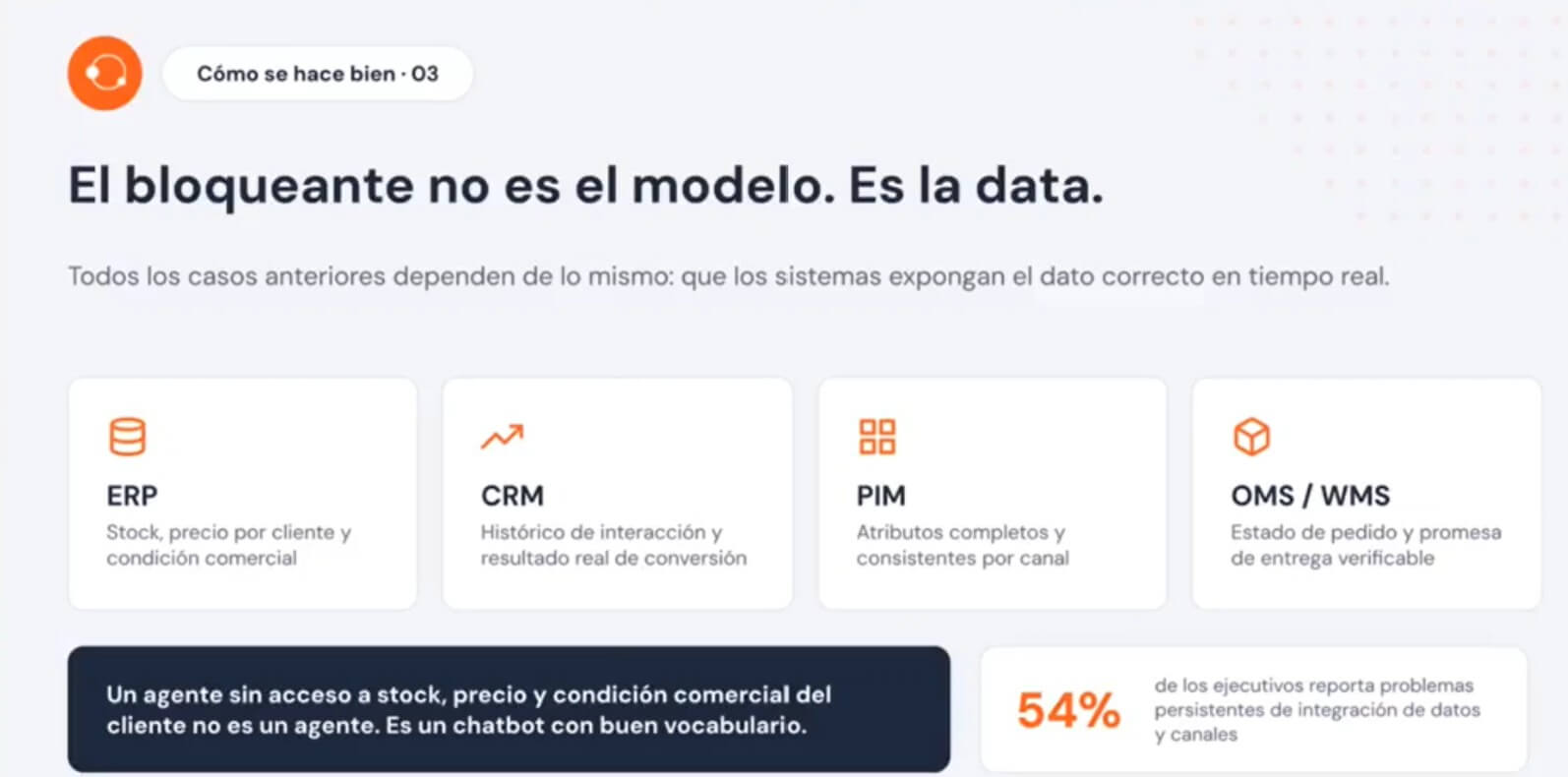
The bottleneck isn’t the model—it’s the data. All of the above cases depend on the same thing: that the systems provide the correct data in real time.
According to Bortz, four integrations are non-negotiable: ERP with real-time inventory, customer-specific pricing, and sales terms; CRM with interaction history and actual conversion rates; PIM with complete and consistent attributes across channels; and OMS/WMS with order status and verifiable delivery promises. An agent without access to this isn’t an agent—it’s just a basic chatbot.
Fifty-four percent of executives report precisely this type of integration problem between systems and channels, and that percentage explains better than any debate about models why a pilot works in the demo but stalls in production.
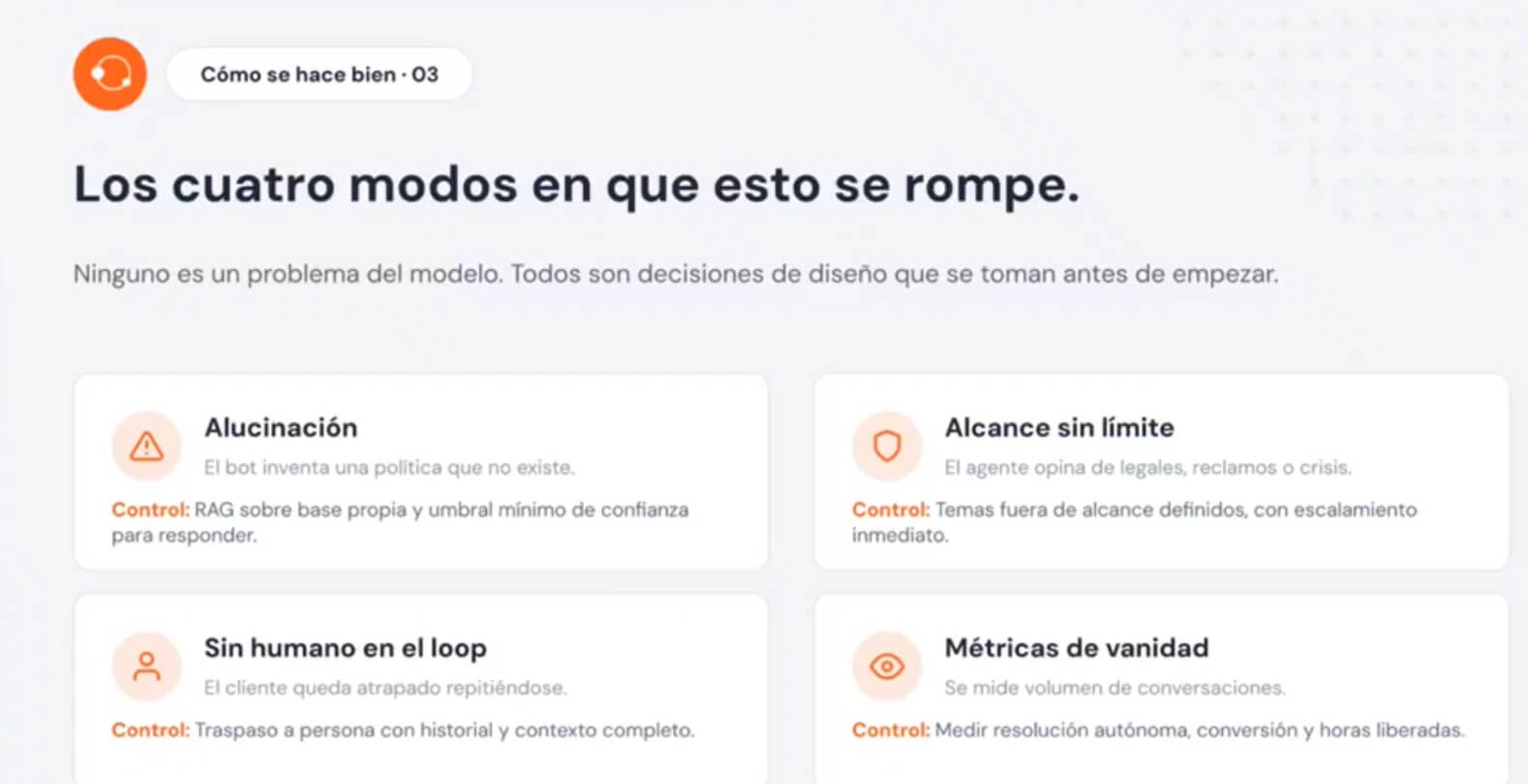
Bortz also identified four specific ways in which an AI project can go wrong, and how to correct each one:
- Agent hallucinations. This is addressed using theagent’s own knowledge base (RAG) and a minimum confidence threshold for responding.
- Unlimited scope. An agent that offers opinions on legal matters, complaints, or crises poses a risk. It is necessary to define which decisions are deterministic and which are not.
- Absence of humans in the process. The customer must not get stuck in a loop of repetition. There must always be a mechanism to transfer the case to a person with the complete history and context.
- Vanity metrics. Measuring the volume of conversations tells us very little. What validates a project’s profitability is measuring problem resolution, conversion, and hours saved.
B2B Commerce: The 90-Day Plan to Avoid Getting Stuck in a Dead-End Pilot
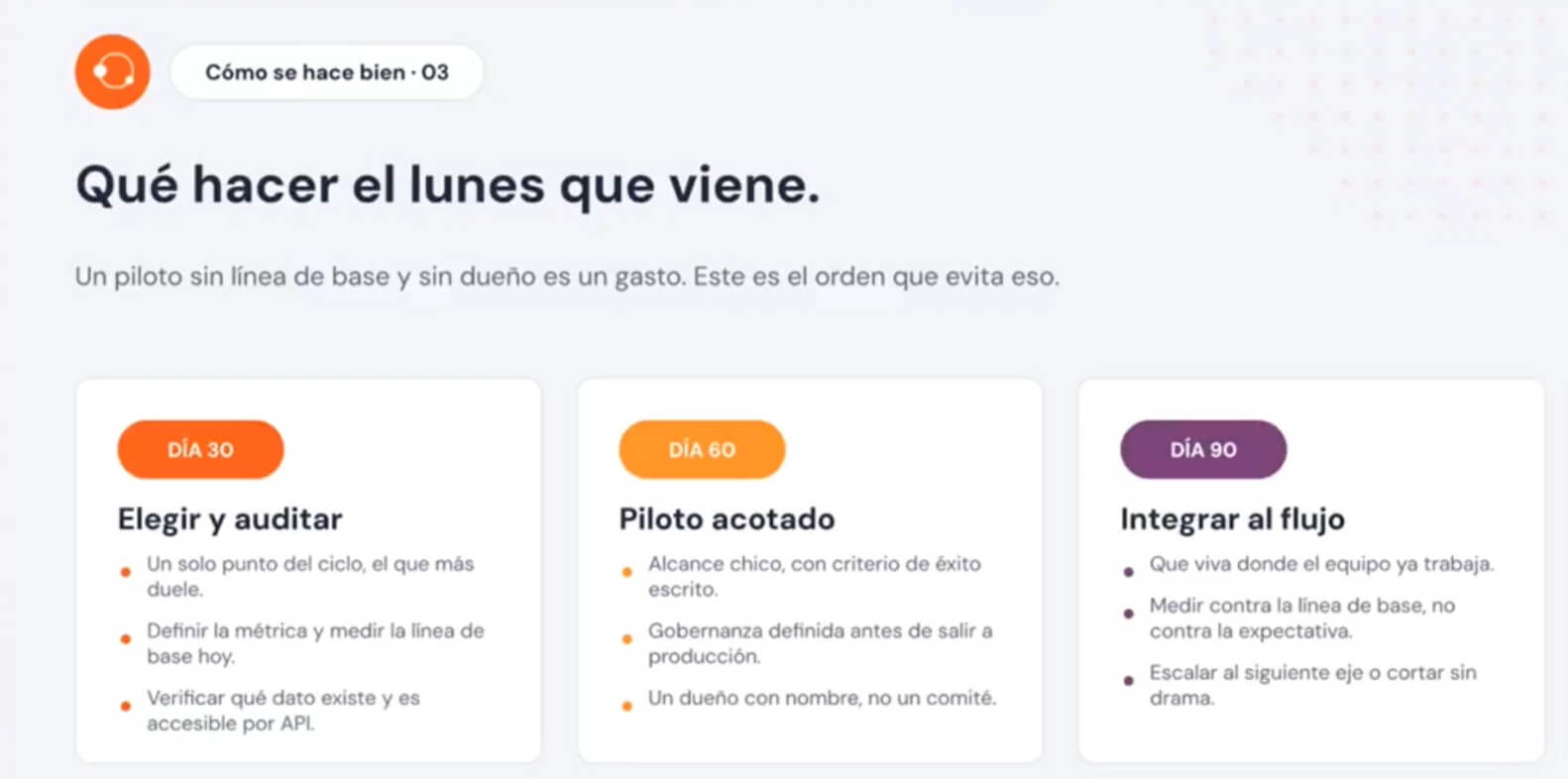
Bortz’s approach was an operational criterion, not a list of tools: choose a point in the business cycle—the one that hurts the most in terms of time or money—and define which metric indicates whether that process is working or not.
The first 30 days are for auditing what data exists and whether it’s accessible via API or an external system.
The next 30 days are for building a limited pilot, with clearly defined success criteria, a governance structure established before going into production, and a specific person in charge—not a committee.
By day 90, the goal is for the solution to be integrated into the team’s actual workflow (Slack, WhatsApp, or whatever channel they already use), to be measured against the baseline rather than against an expectation, and for those insights to enable scaling to the next phase of the business cycle.
What does this mean for your B2B commerce operations?
None of the three cases was resolved by choosing a different e-commerce platform. The solution was found at the integration layer: an ERP connected to the portal to display actual prices and available credit limits per account, a CRM feeding into lead scoring, a product catalog (PIM) structured so that a sales representative could easily navigate it, and a decision engine built on data that the company already had but wasn’t utilizing in a timely manner.
At Known Online, we implement that layer: developing custom integrations between ERP, CRM, and PIM systems; B2B portals on VTEX, Shopify, or Adobe Commerce; and the AI products we mention in this article (Prospect Tracker for lead generation, ChatFlow for conversational self-service, and CatalogAI for catalog structuring), connected to real-time data on inventory, pricing, and commercial terms—not to a static catalog.
If your B2B operation still functions like a store with a larger catalog, the first step isn’t to add a chatbot. It’s to assess whether your ERP, CRM, and catalog can answer Rodrigo Arévalo’s five questions before the customer reaches checkout.
You can watch the full recording of the webinar “B2B Commerce: From Lead to Self-Service” via this link.
Frequently Asked Questions About B2B Commerce and Automation
What is the main difference between a B2C e-commerce site and a B2B portal?
In B2C, the price is set for the product, and payment is made immediately. In B2B, the price depends on the business relationship with each account; payment is typically made on credit with an assigned credit limit; and the purchasing decision involves several people: the buyer, the approver, and the recipient.
What questions must a B2B order answer before it is confirmed?
Five: Who the customer is (identity and account verification), what price applies to them, whether they have available credit, whether there is actual committed inventory, and who the sales representative assigned to that account is.
What Makes a Good B2B Prospect?
With verifiable filters in place before human contact: in the case of Lo Valledor, a valid tax ID number (RUT) with an active business account in the relevant industry, and the depth of the information the prospect provides on the contact form. That filter raised its qualification rate from 20–30% to 70–80%.
Where should AI be implemented first in a B2B business operation?
In the four areas where there is a specific metric to focus on: lead generation and qualification, customer engagement and self-service, catalog and content organization, and providing sales representatives with real-time data on each account.
Why doesn’t an AI pilot go into production even if the model works well?
Because the bottleneck is almost never the system itself: rather, ERP, CRM, PIM, and OMS/WMS systems fail to provide the correct data in real time. Fifty-four percent of executives report these types of integration issues between systems and channels.
What does it mean to “localize” a B2B e-commerce portal?
It’s not just a matter of translating the site into another language: it involves adapting to local business regulations—such as tax compliance, payment terms, collections, public tenders, shipping coverage, and sales units—which no platform handles out of the box.
If your B2B commerce operation needs to integrate ERP, CRM, and a product catalog so that these five questions can be answered in real time, let’s talk.