



To understand the real impact of AI on marketplaces, six leaders in marketplace operations in Latin America sat down to answer the same question from different perspectives : How are they using data and Artificial Intelligence to make better decisions regarding pricing, inventory, and revenue on marketplaces?
The short answer—repeated in different ways by each of them—was the same: selling more on a marketplace doesn’t guarantee higher profits. Revenue goes up, but margins are eroded by poorly calculated commissions, misallocated inventory, checkouts with friction, and data that lives in silos that don’t communicate with one another.
In the webinar “Marketplaces 2026: How to Protect Margins and Scale Without Losing Control,” organized by Known Online, experts from Walmart Chile, Multivende, Producteca, ANYTOOLS, Klap, and Icomm Marketing presented, session by session, where those losses are hidden and what processes can be automated to stop them from occurring.
Frictionless Growth: How to Scale Your Sales Efficiently
Joaquín Risco, Marketplace Manager at Walmart Chile (Líder), opened the session with the question that 3PLs and major brands ask themselves before scaling up: When does a seller’s growth begin to become operationally inefficient?
Its response is based on metrics, not intuition. Walmart tracks trends in cancellations, returns, complaints, and late shipments by category, seller size, and individual seller history. When a seller exceeds those thresholds, the process is phased: first,warnings are issued, followed by specific guidance on which metric is being exceeded and why; and if the problem persists—typically during demand spikes such as seasonal campaigns—the platform invites the seller to join Walmart Fulfillment Services (WFS) to handle the logistics operations that the seller cannot manage on their own.
Risco identified two specific challenges that hinder brands transitioning from traditional distribution to D2C within a marketplace:
- Underestimating the attention this channel requires. A store on a marketplace needs the same level of attention as a brick-and-mortar store: a product catalog, photos, participation in campaigns, and, above all, staff dedicated to maintaining it. Without that, the customer experience suffers, and the customer becomes a detractor rather than a promoter.
- Not investing in technology integration. Sellers who connect directly via API to manage sales, track packages, and resolve issues are, in their experience, much more likely to sustainably grow their sales. Without integration, each additional Seller Center (a second or third country, a second or third marketplace) becomes an operational cost that ultimately places an artificial ceiling on growth.
The criterion he proposed for assessing whether a seller is ready to scale up is to break down the P&L by product and by channel, understanding what drives each cost (logistics by volume or weight, take rate by category, advertising investment) and allocating it responsibly to each SKU. “Getting that figured out is 80% of the work; the rest is management,” he summarized.
Smart Inventory: The Biggest Competitive Edge
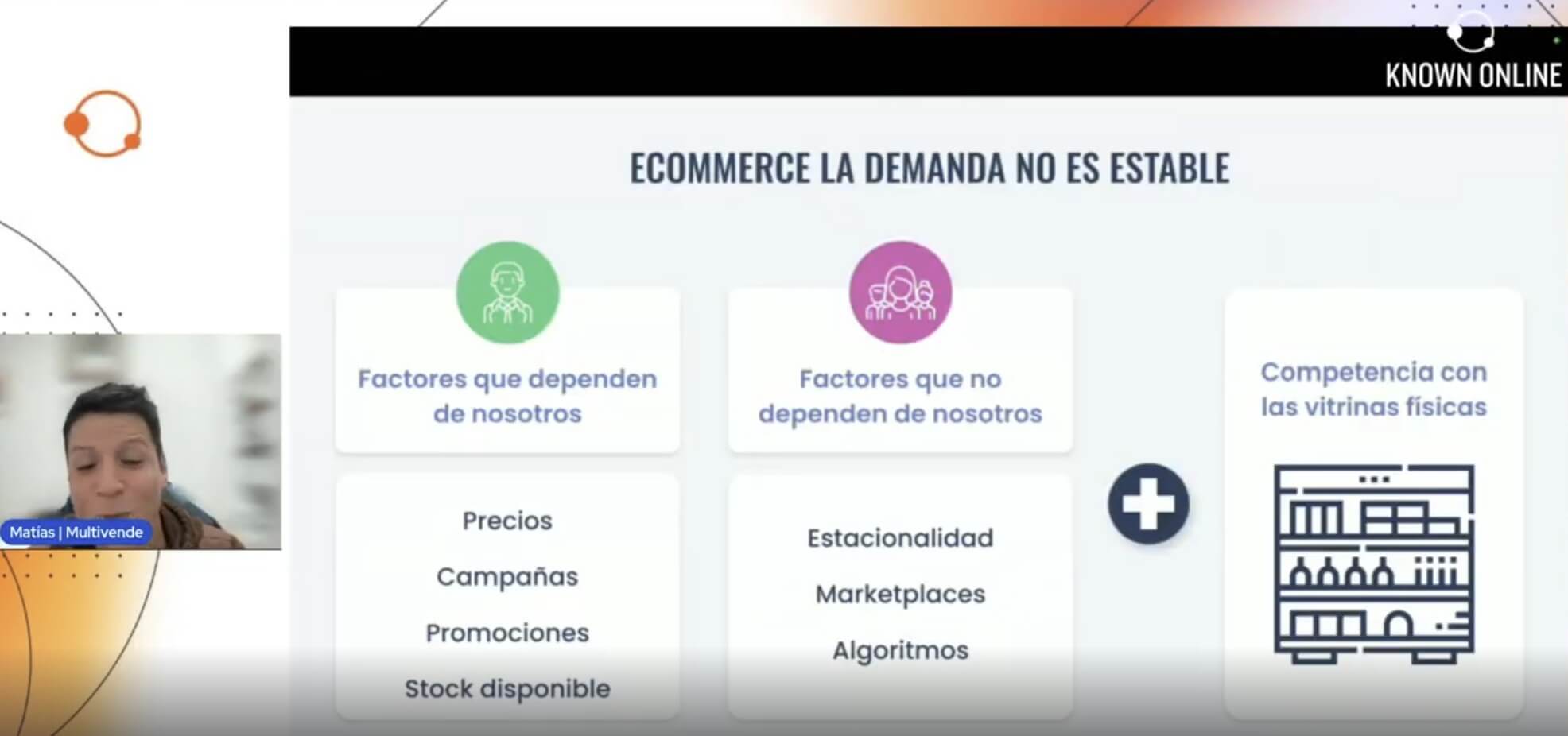
Matías Barahona, CEO and founder of Multivende, cited a real-life example: a large seller in Chile that sold nearly 3,000 units of a product during the holiday season, with an average order value of USD 30. The same sales data is interpreted differently depending on who is looking at it: the general manager sees the total revenue; the CFO sees inventory dropping from 3,000 to 0 units; the e-commerce manager sees the cumulative trend by channel; and the operations team sees the daily, non-cumulative sales volume for each channel.
At that final level of detail, the patterns that determine whether the margin is protected or eroded become apparent: channels competing with each other for the same inventory, discounts in one channel that cannibalize sales in another, and demand spikes that coincide across platforms without anyone having coordinated them. Conducting that analysis manually for a catalog of thousands of SKUs is, in Barahona’s words, impossible.
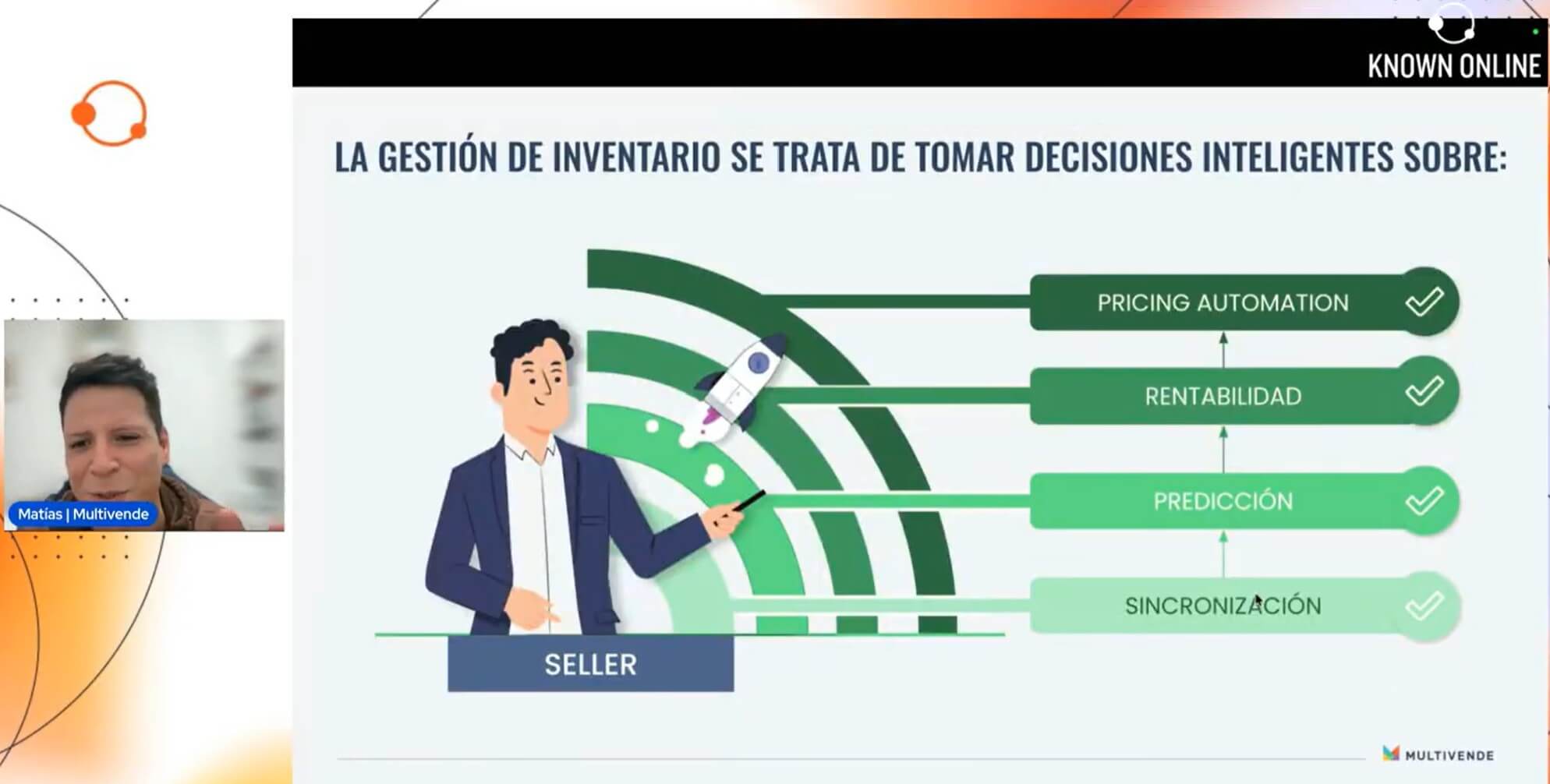
Multivende proposes a four-tier inventory management system in which each tier builds upon the one below it:
- Centralized, real-time inventory synchronization. Manually allocating inventory across channels (for example, dividing 100 units into fixed portions) leads to shortages in one channel while creating excess in another.
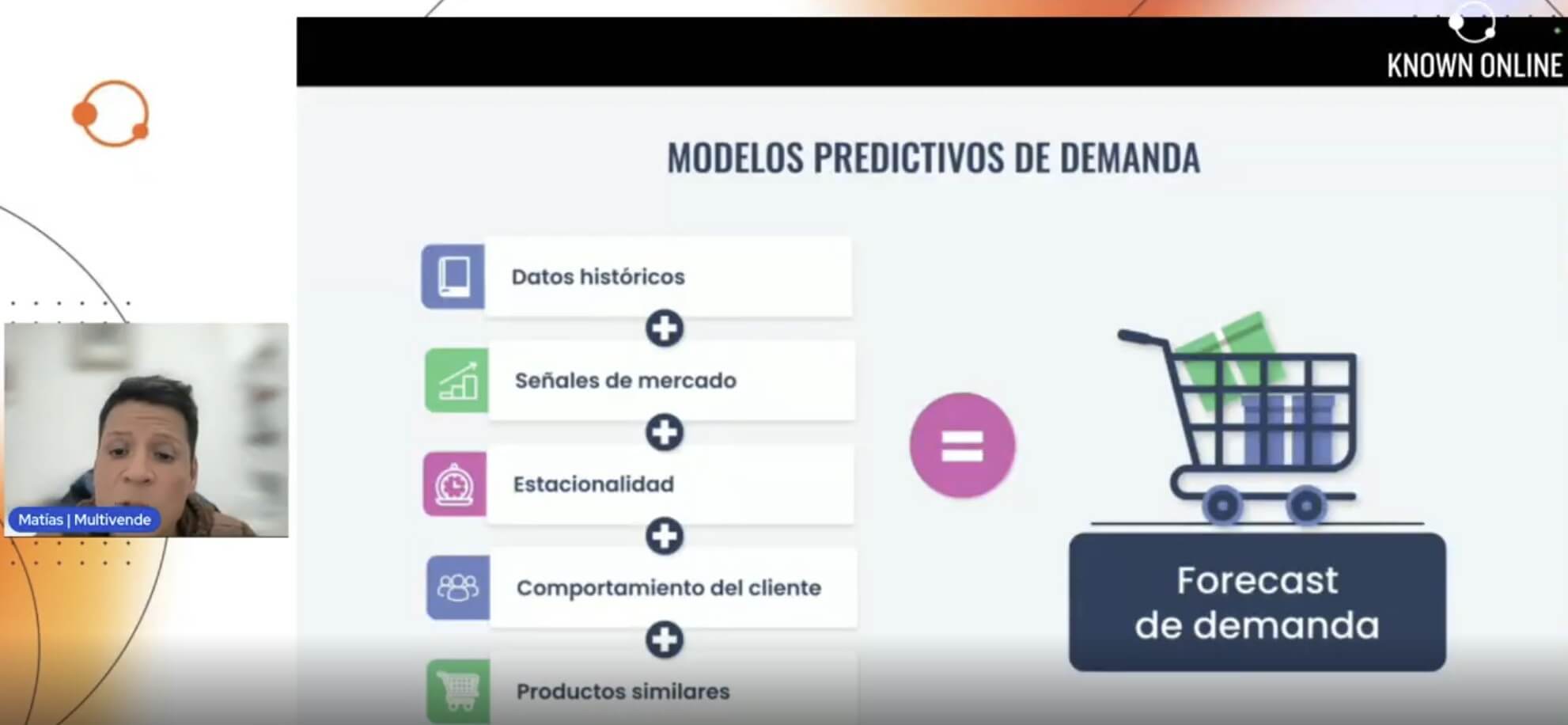
- Demand forecasting using machine learning models, which cross-reference historical data, market signals, seasonality, customer behavior, and similar products to generate a probabilistic forecast rather than a linear projection.
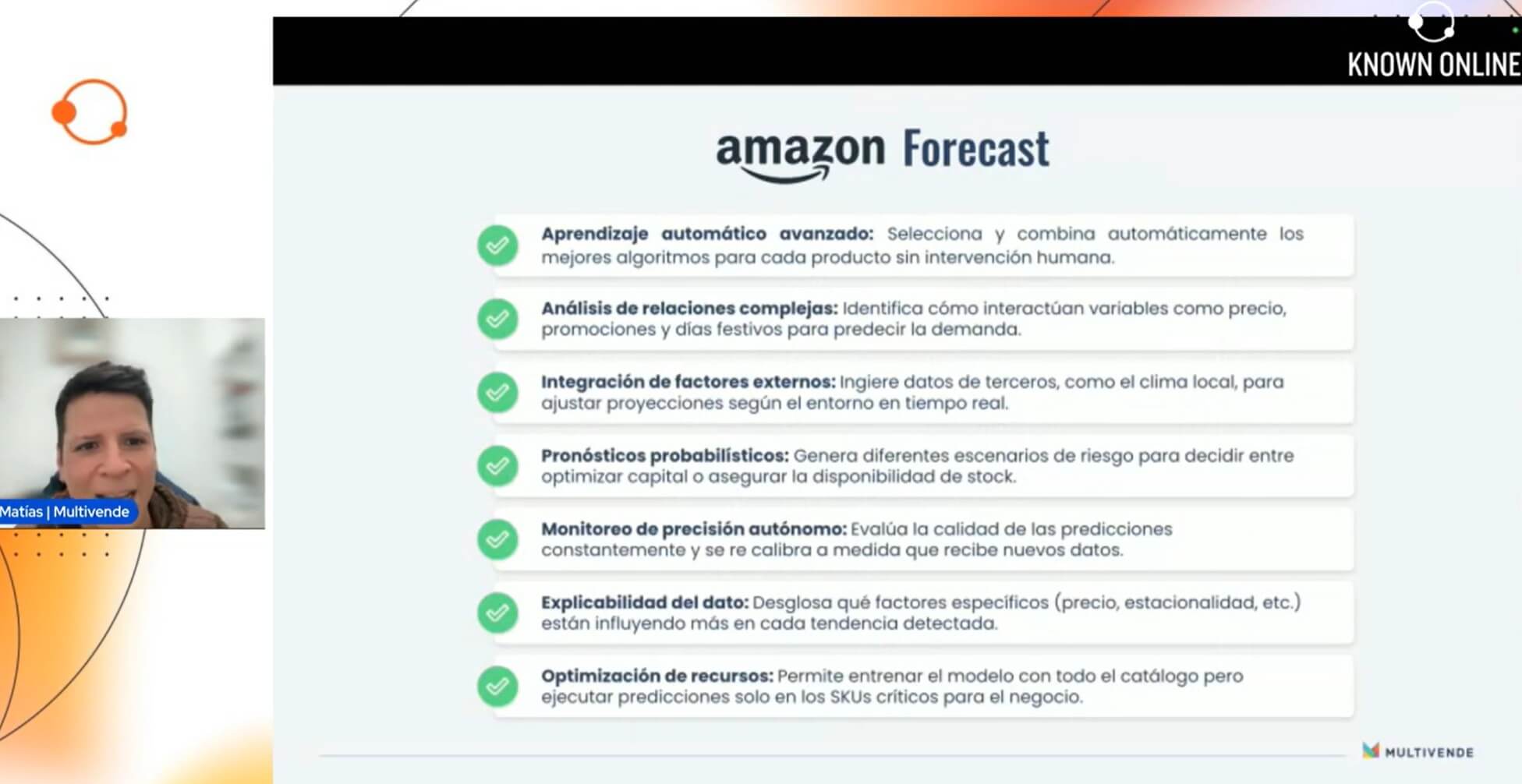
As an example of this layer, Barahona demonstrated how Amazon Forecast works: a model that automatically selects and combines algorithms based on the product, cross-references variables such as price, promotions, and holidays, incorporates external factors such as the weather, generates probabilistic forecasts (not a single figure), and autonomously recalibrates itself as it receives new data.
- Managing stock shortages without hiding products. When a top-selling SKU starts to run low, lowering the listed stock or deactivating the listing hurts the store’s search ranking on the marketplace and makes the store look empty.
- Pricing automation as a regulatory mechanism. Instead of restricting supply, the price is adjusted: it rises in the least profitable channels, and the most competitive prices are reserved for the priority channel, thereby protecting margins without removing the product from circulation.
Barahona linked this to the seller’s maturity: in the early stages, the focus is on having a presence across various channels with simple listings; in the intermediate stages, on integrating operational workflows with internal systems such as billing and ERP; and in the advanced stages, on full automation through integration with WMS and pricing and inventory tools. Multichannel catalog management, he said, remains one of the biggest challenges for brands as they scale.
Integrate AI where it adds real value: automate, anticipate, and optimize operations between the seller and the marketplace
Andrés Kirschbaum, CEO and co-founder of Producteca, divided the benefits of AI into two categories: obvious costs and hidden costs.
In terms of direct costs, AI reduces the number of hours spent on tasks that were previously done manually: selecting categories, mapping attributes, and transforming images to meet the requirements of each marketplace, as well as automating pre-sales and post-sales responses.
Hidden costs are less visible but just as real. If a product is listed without all the required attributes, it won’t appear in search results. If the information is entered incorrectly, the likelihood of a return increases. Every avoidable return represents an opportunity cost that doesn’t appear on a sales report but does impact the period’s bottom line.
Regarding the difference between automating for the sake of automating and automating to protect margins, Kirschbaum was straightforward: the difference lies in which variables factor into the decision. Maximizing the Buy Box can increase sales and, at the same time, erode margins if it isn’t weighed against logistics costs, marketplace fees, and inventory turnover.
Regarding preparing for rule changes—one of the biggest sources of operational friction on marketplaces, which modify categories, required attributes, and policies without prior notice—he distinguished between two types of changes:
- Announced changes—which come through the marketplaces’ own partner programs—require adjusting the integration code as quickly as possible. That’s where Kirschbaum sees AI’s greatest impact today: in generating code to adapt integrations to the pace at which marketplaces change.
- Unannounced changes that require observability: detecting immediately when a product stops being indexed properly due to a modified category or attribute, and correcting the issue before the error accumulates.
Regarding managing massive catalogs without sacrificing quality, he explained that Producteca’s focus is on the resilience of integrations and on a monitoring center with traceability and alerts, to which they are adding AI so that it not only detects the problem but also suggests the necessary changes to the integration. As a minimum requirement for scaling to multiple channels and countries, he noted the need for an ERP system that can integrate with the online world and a team with clear project leadership: technology handles the scaling, but it doesn’t replace the need for someone to be in charge.
The real problem: selling more ≠ earning more
Rodolfo Helmbrecht, Executive Director of ANYTOOLS for Latin America, put numbers to the problem discussed throughout the session. For sellers whose annual revenue ranges from $100,000 to $500,000, it’s common for profits not to grow at the same rate as sales, and the reason lies in costs that aren’t visible on the standard dashboard:
- The actual commission is not the same as the agreed-upon commission. A seller may have a contractual commission of 12% to 15%, but when reconciling payments and adding expenses, penalties, and additional fees, the effective commission can reach 20% or 23%.
- Logistics costs vary by method (marketplace fulfillment or in-house delivery, such as Flex) and by product, and each marketplace has different campaign payment rules: some pay immediately, others in the next billing cycle, each with its own discount.
- Returns can put an order in the red, especially when the actual cost of the return (reverse logistics, products that aren’t returned to the warehouse) isn’t known until one or two months after the sale.
Helmbrecht also identified an operational signal that rarely appears in a traditional financial report: the decision not to ship an order when there is already an open claim, because the likelihood of a return is high and the cost of reverse logistics may exceed the sale itself. ANYTOOLS turned that informal practice into a cancellation risk alert within its suite.
To protect margins without losing competitiveness against players who compete solely on price, he proposed refining the product mix strategy: identifying “champion” products (those that generate real profit, not necessarily the highest-volume ones) and using complementary products as a sales lever with brands or partners, rather than applying across-the-board discounts to the entire catalog.
He concluded with a point about cash flow in campaigns: selling, invoicing, and collecting payments do not happen at the same time. If a campaign depletes inventory but payment from the marketplace takes 30 or 60 days, the business may run out of cash to restock just when demand remains strong, losing the profitability the campaign was supposed to generate.
Transactional efficiency: the final bridge to liquidity
Attilio Ferretti, Head of E-commerce at Klap, shifted the conversation to the part of the funnel that is least often measured: the checkout. His argument is that the payment acceptance rate—the percentage of completed transactions that are actually processed—is underestimated compared to variables such as traffic, price, or logistics, even though an avoidable rejection ruins a sale that was already in the bag.
Regarding reducing payment friction, Ferretti pointed out that it’s not just about minimizing steps: trust in the payment method is just as important as speed, and it varies depending on the buyer segment. One example he gave is that of longer but familiar authentication methods, which certain segments prefer precisely because they build trust, as opposed to two-click digital wallet payments that other segments demand for speed.
On the subject of reconciliation, he was unequivocal: automated reconciliation is the path that large retailers are already taking, via API or SFTP, because at the end of the month, manually calculating how much was sold versus how much was actually paid (excluding cancellations and chargebacks) creates a discrepancy that becomes increasingly difficult to manage as sales volume grows.
Regarding the use of transactional data as an early indicator for pricing and promotions, he mentioned that the most advanced retailers request real-time dashboards showing cart abandonment rates by active promotion, because a poorly calibrated promotion (for example, a product price discount that is offset by a shipping cost that increases at checkout) can cause customers to abandon their cart right at the final step. He also highlighted a distinction that is often overlooked in reports: not every unapproved transaction is a rejection; a significant portion consists of expired transactions, where the buyer simply abandons the payment process without the system counting it as either a rejection or an approval.
Data Activation & AI in Marketplaces: How to Unify Data to Automate High-Conversion Experiences
Marcos Ayala, Business Development Lead at Icomm Marketing, wrapped up the webinar by highlighting the issue that ties all of the above together: Data from a single customer often resides in silos that don’t communicate with one another—both across different departments within an organization (marketing, collections, customer service) and across different channels (physical stores, e-commerce, marketplaces ).
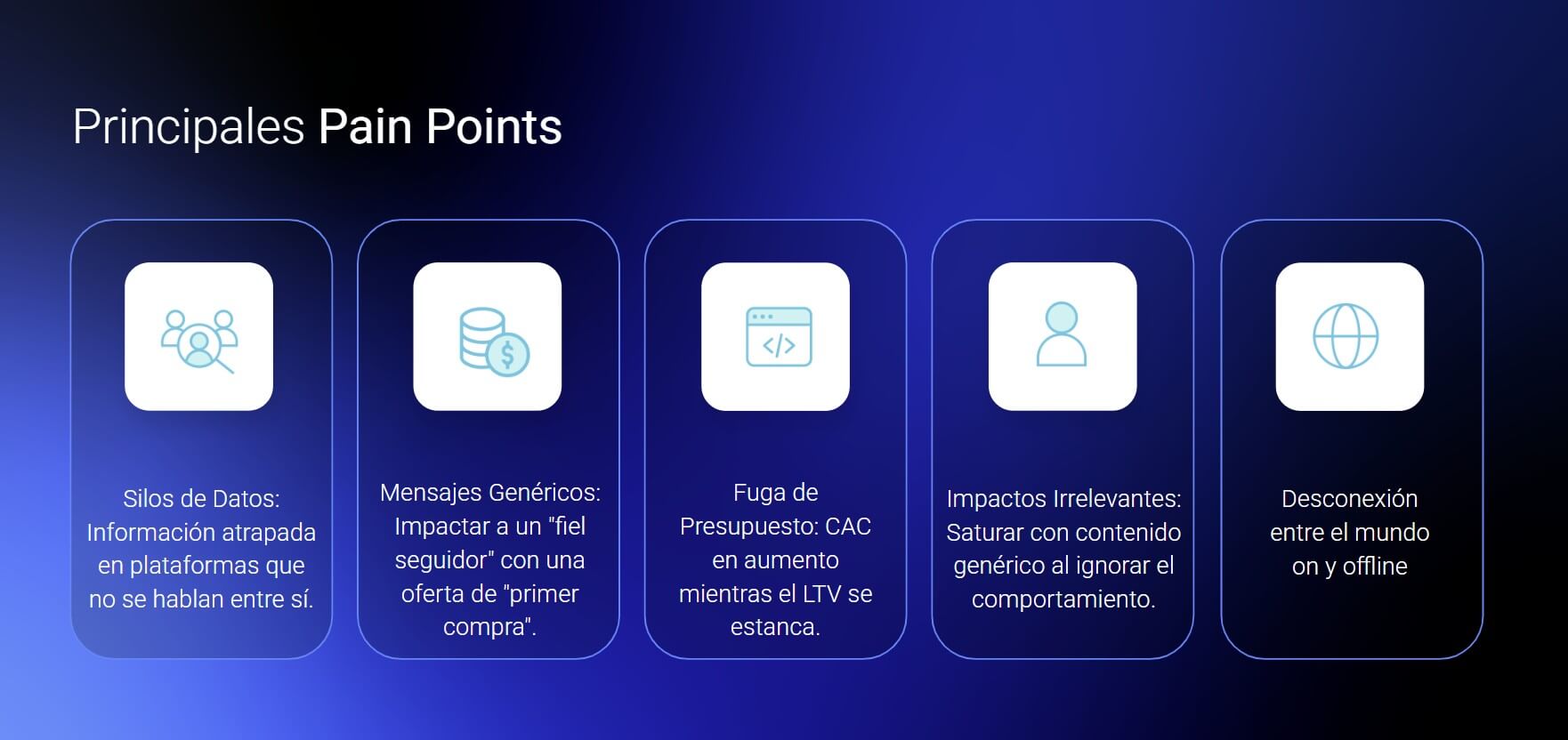
The cost is clear: generic campaigns with open rates that drop to 10% or 15% when sent out en masse and on a recurring basis; an acquisition budget that rises while the customer’s lifetime value does not grow at the same rate; and a disconnect between what happens in the online world and the physical world.
The solution proposed by Icomm involves consolidating that information under a unique customer identifier (RUT, phone number, or email address, depending on what each business collects) and segmenting it using an AI-enhanced RFM model (recency, frequency, monetary value), which allows for the creation of dynamic audiences rather than static lists: a new customer, a loyal customer, one at risk of churning, and a lost customer each receive different communications, through the appropriate channel and at the right time.
Ayala shared a key finding: when communication is based on actual behavior (for example, after a customer has interacted with specific content) rather than being sent out in bulk, engagement increases by 10% to 30%. Automation, in his view, does not replace business strategy: it makes it executable at the scale the business needs without requiring a hand-crafted campaign for each segment.
Profitability hinges on the data that no one is looking at
The six talks describe the same problem from six different points in the funnel: operational thresholds, inventory, technology integration, actual cost per order, checkout, and fragmented data. In all six cases, the solution was not to sell less or slow down growth: it was to measure with the right level of granularity and automate the decision that was previously made—or not made—blindly.
You can watch the full recording of the webinar at this link.
How We Implemented It at Known Online
Each of the pain points described by the six speakers has a specific technical solution. At Known Online, we work on these six areas to ensure that marketplace operations are maintained according to the same criteria used in their design:
- Seller Center: Centralize the management of your current account with sellers using our Seller Center, which is integrated with the leading e-commerce platforms and features a modular structure that adapts to each marketplace model.
- Development and Integrations: We design and develop the online store and internal systems using our own software and e-commerce platforms such as VTEX, Adobe, or Shopify. We organize and connect your product catalog, sellers, and sales workflows to facilitate integration and scalability.
- Process Automation: We optimize key tasks such as product management, order processing, content publishing, and performance tracking using customized automation tools.
- Data Analytics and AI in Marketplaces: We connect data sources to gain actionable insights and optimize business decisions.
- Comprehensive digital marketing strategies: Campaigns designed to attract qualified traffic, engage users, and build loyalty with a focus on performance and profitability.
- Custom Data Modules: Dashboards, reports, and cross-platform integrations (ERP, CRM, CMS, e-commerce) that drive evidence-based decision-making.
Frequently Asked Questions About AI in Marketplaces
How do you protect profitability on marketplaces as sales grow?
By breaking down the analysis by channel and by SKU rather than looking only at total revenue. Operational thresholds (cancellations, returns, late shipments), the actual commission after reconciling payments, and logistics costs by delivery method are the three variables that, if not monitored, cause sales to grow while profits lag behind.
Why does a marketplace’s commission end up being higher than the agreed-upon commission?
This is because, in addition to the base commission, there are charges that aren’t always visible in the standard report: fines, fees, and costs associated with returns. Reconciling payments line by line—rather than using the contractual percentage as a reference—is what allows you to see the actual commission.
What are hidden logistics costs in e-commerce, and how are they calculated per SKU?
These are the costs that vary depending on the shipping method (marketplace fulfillment or in-house shipping), the weight or volume of the package, and the reverse logistics involved in a return. Calculating these costs by SKU—rather than as an average across the entire catalog—is what allows you to identify which products are profitable and which are operating at a loss without the team realizing it.
What is a profitability or margin audit by SKU on marketplaces?
This exercise involves assigning actual costs—such as commission, logistics, advertising, and returns—to each product to identify which ones generate actual profit and which ones only generate volume. Without this breakdown, a campaign or promotion may appear successful in terms of sales but result in a loss in digital EBITDA.
How does artificial intelligence help optimize the product catalog across multiple marketplaces?
Automating tasks that are unfeasible to perform manually: mapping attributes according to each platform’s requirements, converting images to the format required by each channel, and early detection of products that are no longer indexed due to a category or attribute change not announced by the marketplace.
What is dynamic pricing, and how does it differ from simply lowering prices to compete with rivals?
It involves adjusting prices based on business variables—available inventory, profitability by channel, projected demand—rather than simply reacting to what the competition charges. It is used both to protect margins when a product is in short supply (by raising the price rather than taking it off the market) and to avoid price wars that erode the entire distribution channel.