



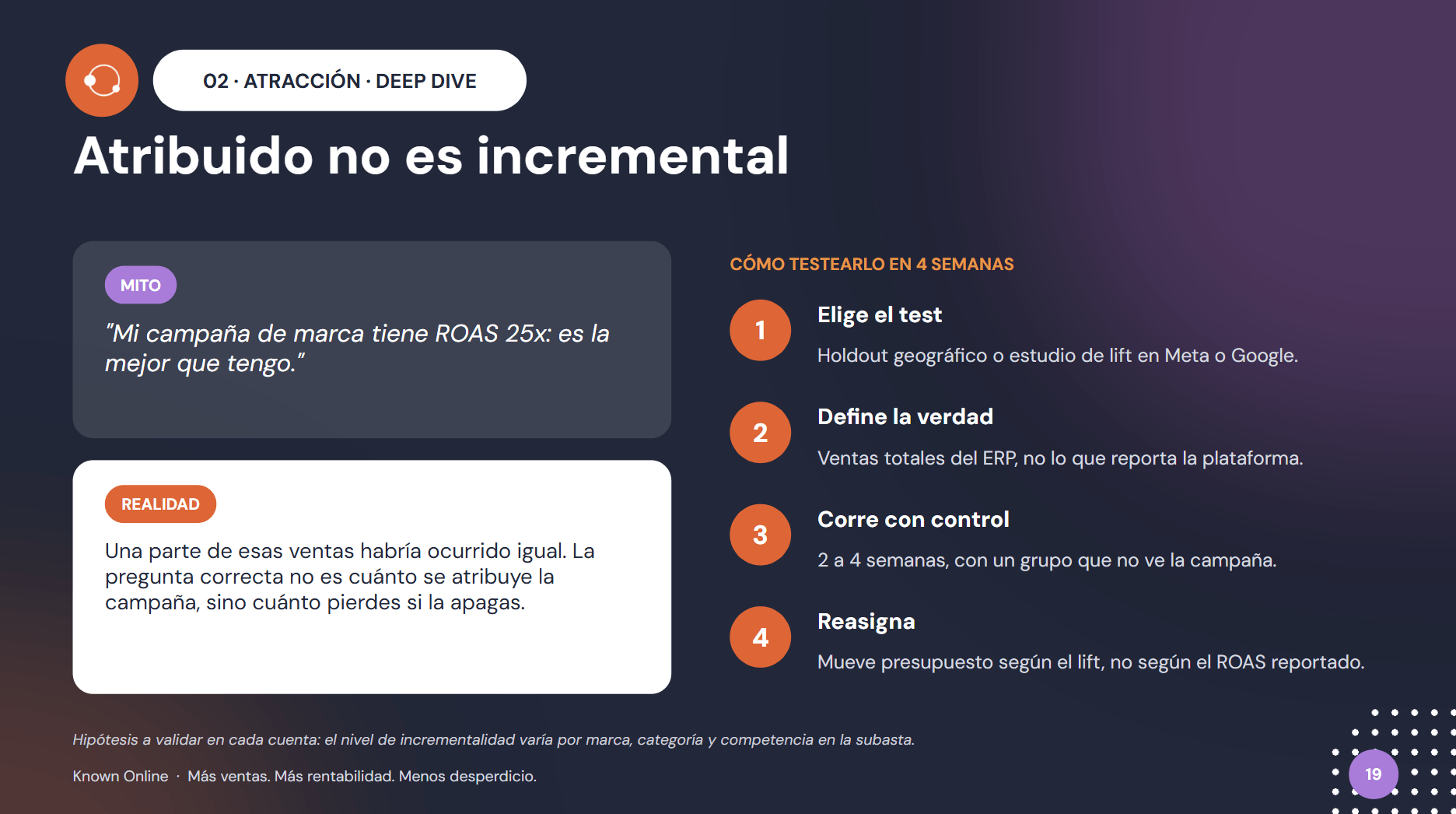
3 quick wins to help your ad campaign drive new demand: use the feed as a strategy, plug budget leaks, and turn your creative into new targeting. “My brand campaign has a 25x ROAS: it’s the best one I have.” It’s a phrase we hear often, and it rarely tells the whole story. Some of those sales would have happened anyway, with or without the campaign. That’s why the useful question is how much you lose if you turn it off, rather than how much is attributed to it. With that as his starting point, Ariel Bortz, COO of Known Online, kicked off the “Attraction” segment of our webinar “More Sales. More Profitability. Less Waste”—discussing how to do performance marketing for e-commerce when AI already determines the audience, bid, and budget.
The key decision: Do you pay for new demand or for the demand you already had?
If the investment focuses on existing demand, the customer acquisition cost skyrockets. If it drives new demand and that demand is retained, the customer acquisition cost remains limited. This distinction determines how to allocate the budget across media channels.
Performance Marketing for E-commerce: The Algorithm Decides; the Team Feeds It
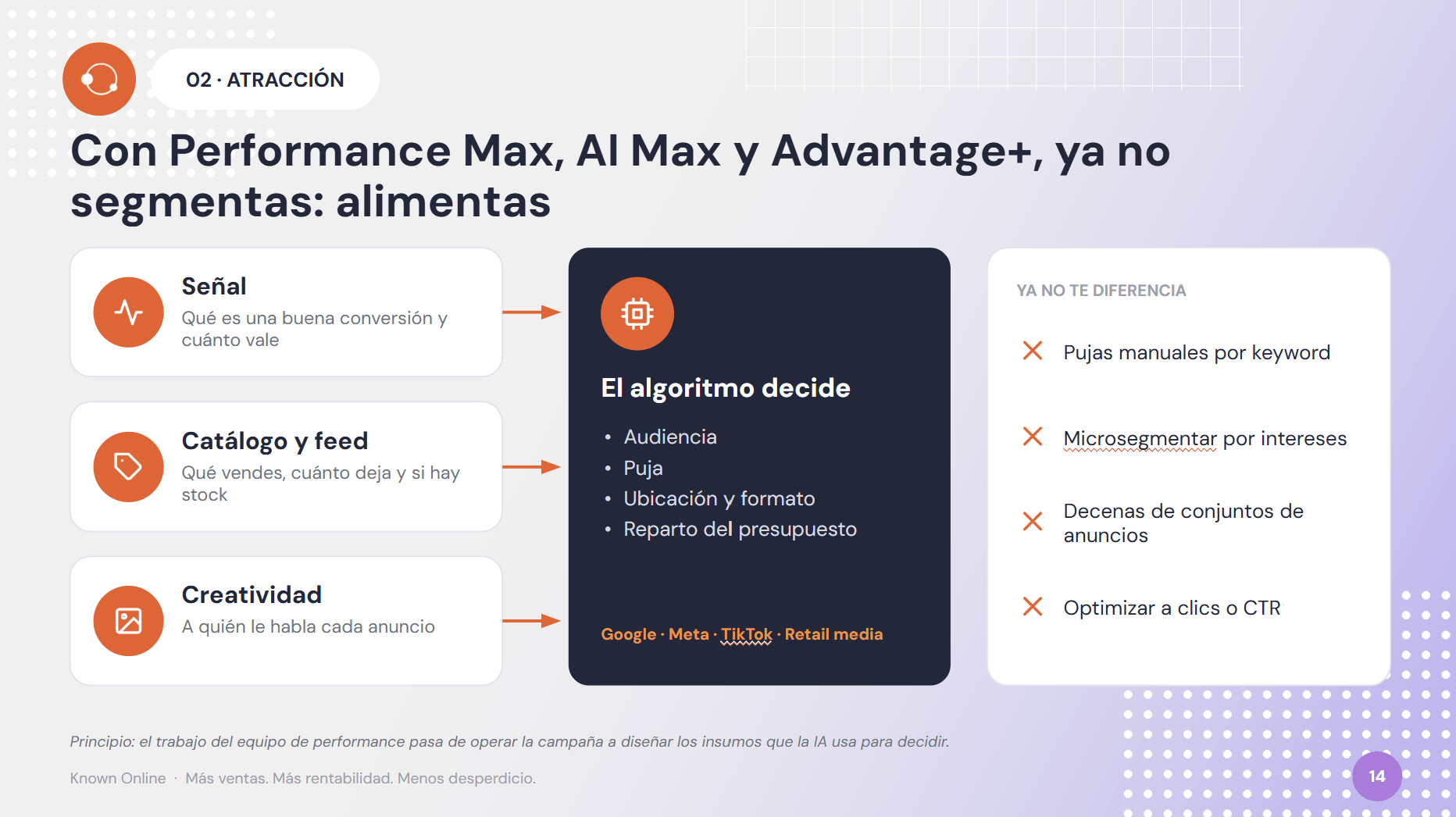
With Performance Max, AI Max, and Advantage+, the algorithm now determines the audience, bid, placement, format, and budget allocation. This applies to Google, Meta, TikTok, and retail media. What used to be set up manually ten years ago—such as segments and keyword lists—makes little sense today.
Several practices no longer set one account apart from another: manual keyword bidding, interest-based micro-targeting (which can even be counterproductive today), dozens of ad groups, and optimization by clicks or CTR.
What does make a difference, however, are three key factors:
- The Signal: What Constitutes a Good Conversion and How Much It’s Worth.
- The catalog and feed: what you’re selling, how much profit it brings, and whether it’s in stock.
- Creative: Who each ad is targeting.
The performance team’s role shifts from running the campaign to designing those assets.
Quick Win 01 · The Feed as a Strategy
Low effort · High impact
- Create custom labels based on margin, inventory, and turnover.
- Group campaigns by margin level.
- Craft titles based on what people are searching for: brand, product type, and attribute.
AI enables us to enhance titles, descriptions, and attributes across the entire catalog. At Known Online, we use CatalogAI and feed rules to do this, and we measure its effectiveness by the percentage of the catalog that receives impressions.
Quick Win 02 · Plug Budget Leaks
Low effort · High impact
- Exclude your brand from Performance Max.
- Automatically pause out-of-stock SKUs.
- Exclude recent buyers from prospecting campaigns.
With AI, search terms can be classified by intent and relevance. We link these rules to the inventory in the OMS or ERP. The metric is the percentage of the budget spent on out-of-stock products or irrelevant searches.
Quick Win 03 · Creativity Is the New Segmentation
Medium effort · High impact
- Keep in mind that on Advantage+ and TikTok, the ad selects its own audience.
- Create distinct concepts, not variations of the same ad.
- Work on four angles: pain, social proof, offer, and usage.
AI generates variations by concept and identifies which angle performs best in each segment. We work with a monthly matrix of angles by format, including testing, and measure the percentage of ads that fall below the target CPA.
Each media channel has a specific role: don’t measure them all using the same ROAS metric.
| Middle | Role in the funnel | Measure it by | Typical error |
| Google Search and Shopping | Capture existing demand | POAS and incremental CPA | Paying for your own brand without measuring whether it was necessary |
| Performance Max / AI Max | Scale with signal and feed | POAS by margin tag | Allow brand cannibalization and remarketing |
| Meta Advantage+ | Generate new demand | CAC for new customers | Judge it solely by last-click ROAS |
| TikTok and new media | Discovery and creative reach | Qualified visits and brand searches | Reusing Meta ad creatives without adapting them |
| Mercado Ads, Amazon Ads, Walmart Connect | Purchase intent within the marketplace | ACOS/TACOS and net margin after commission | List SKUs that are already losing margin due to commissions and shipping costs |
The rule of thumb: the budget is allocated based on incremental contribution to the margin, without relying on the ROAS that each platform attributes to itself.
Attributed and incremental metrics measure different things
To determine how much each campaign actually contributes, we suggest a four-week test in four steps:
- Choose the test: geographic holdout or lift study on Meta or Google.
- Define the truth: total sales from the ERP, not what the platform reports.
- Run the test with a control group: over 2 to 4 weeks, with a group that doesn’t see the campaign.
- Reallocate: shift the budget based on lift, not on reported ROAS.
The level of incremental impact varies depending on the brand, category, and competition in the auction. That is why this is a hypothesis that must be validated for each account.
If you’d like to learn more about why a larger advertising budget doesn’t necessarily mean higher profitability, we discussed this in a previous post.
The webinar recording is available here.
At Known Online, we manage performance marketing for e-commerce on Google, Meta, TikTok, and Mercado Ads, using margin-based feeds and rules linked to inventory. Contact us.
Before increasing your budget, calculate how much you would lose if you paused each campaign.
Frequently Asked Questions About Performance Marketing for E-commerce
What are custom feed tags?
They are attributes added to each product (for example, its margin level, inventory, or turnover) to group campaigns and bid differently for each group.
What are ACOS and TACOS?
ACOS is advertising spend divided by sales attributed to ads. TACOS is advertising spend divided by total sales. On marketplaces, it’s best to interpret these metrics alongside the net margin after commission.
Is it a good idea to continue running ads under your own brand?
It depends on each account. A common mistake is paying for your own brand without assessing whether it was necessary. An incrementality test provides the answer.
What is a geographic holdout?
It’s a test in which the campaign is paused in one area and kept running in another comparable area. The difference in sales between the two, measured in the ERP, shows the campaign’s actual contribution.