


The Logistics has evolved from a supporting function to a critical factor in conversion, customer experience, and profitability. This webinar brought together five leading figures in Latin American e-commerce logistics to quantify something that most teams sense but don’t fully measure: Logistics costs are rising, customers are demanding ever-faster deliveries, and profit margins aren’t keeping pace. Any team operating an e-commerce business in Latin America already knows this: logistics is no longer just a “support function”—it has become a critical factor in conversion, customer experience, and profitability.
DHL Supply Chain, Envíame, Pickit, Janis Commerce, and Paquery operate and process millions of orders per month in the region, and this is what they see in day-to-day operations—not just in product theory—regarding where conversion, customer experience, and margins fall short.
They shared it in the webinar organized by Known Online: “E-commerce Operations Under Pressure: How to Maintain Speed and Profitability in Latin America.”
Key points from this article on e-commercelogistics in Latin America:
- DHL Supply Chain and Omnichannel Maturity: The region still has 35 million new internet users to bring online by 2026, and 46–52% of shoppers remain frustrated by costs and delivery times. Logistics maturity is measured on a 4-level scale, ranging from unsystematized, independent inventory to an integrated network of fulfillment centers with full visibility.
- Send Me and the Hidden Costs: 1 in 10 orders in Latin America has a delivery issue, and 80% of those incidents are caused by the carrier, not the customer. The costs that truly erode margins—redeliveries, reverse logistics, back-office expenses, and lost repeat customers—don’t appear on any invoice.
- Pickit and end-to-end connectivity: connecting the first and last mile within a single ecosystem achieves 99% effectiveness and a 98% SLA, with incident resolution up to 72 hours faster than the industry standard.
- Janis Commerce and the limits of cost-cutting: A real-world case study showed that reducing expenses by 15.96% compared to the budget generated only “slight operational leverage,” which was insufficient to offset a 14.29% drop in sales. The lesson: cutting costs is not the same as managing the business.
- Paquery and the same-day dilemma: Logistics no longer merely keeps pace with business growth—it defines it. Maintaining fast deliveries without sacrificing profitability requires segmenting delivery promises (not every order needs to be same-day) and prioritizing operational efficiency over speed at any cost.
- Webinar conclusion: The order doesn’t end at checkout. It ends when the package arrives and the customer trusts the brand enough to make another purchase; that “last mile” is, today, the least managed variable in the digital P&L.
DHL Supply Chain: Omnichannel maturity is measured by inventory, not by the catalog
Camila Furlan, LATAM eCommerce Director at DHL Supply Chain, opened the webinar with the question that served as the title of her talk: How does omnichannel retail benefit from an efficient supply chain?
The market context:
- Internet penetration in Latin America averages 83%.
- The region is expected to add 35 million new users connecting for the first time between 2024 and 2026, approaching full penetration.
- Access to financial accounts still lags behind that figure in several markets; hence, cash-on-delivery remains relevant.
- Local solutions such as PIX in Brazil or PSE in Colombia are bridging the gap between “I want to buy” and “I can pay.”
The frustrations of online shoppers, by name. Furlan presented a survey on what frustrates online shoppers in the region the most today:
- High shipping costs.
- Long delivery times.
- Insufficient product information.
- Having to pay for returns.
- Insufficient product images.
On the other hand, what those same shoppers expect in return: free shipping, free returns, faster delivery, better product descriptions, and recommendations based on real customers and photos. Neither of these two lists is about marketing: they are, at their core, a supply chain problem with conversion-related symptoms.
The 4 Levels of Maturity in Omnichannel Logistics. Based on data from VTEX and DHL, any e-commerce manager can use this model today to determine where their operation stands:
- Starting point: fulfillment with independent inventory and unsystematized operations.
- Centralized inventory in one or two distribution centers, with a system but no true cross-channel integration.
- Decentralized inventory and data-drivenpredictive assortment, designed to increase speed and improve last-mile costs.
- Integrated inventory and order management, with visibility and joint management across an entire network of fulfillment centers and distribution centers.
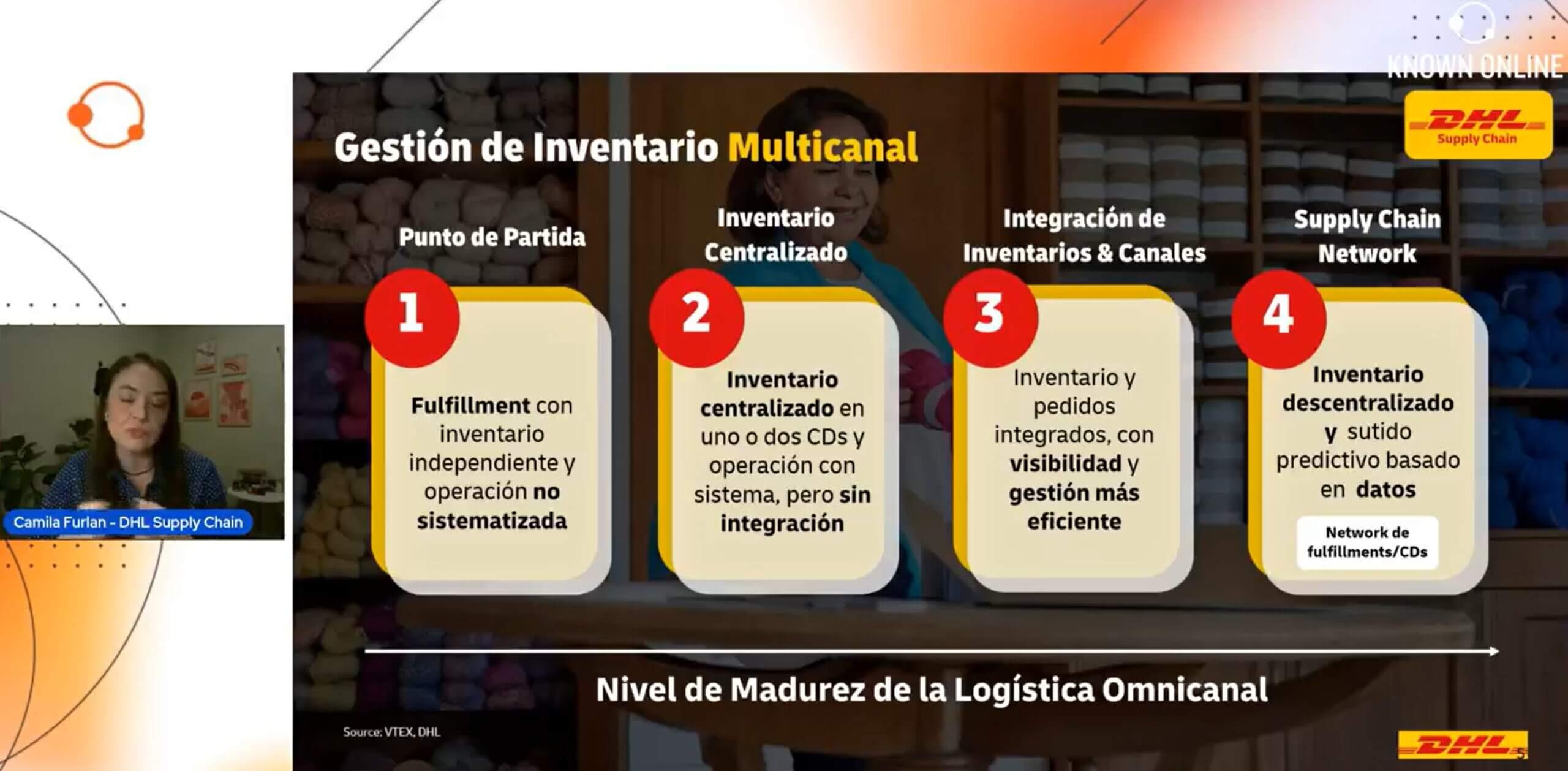
According to DHL’s analysis, most retailers in the region still operate at levels 1 and 2—that is, with inventory that cannot communicate with other channels in real time.
The Next Digital Wave, Trend by Trend. Furlan concluded by linking each consumer trend to its corresponding logistics challenge:
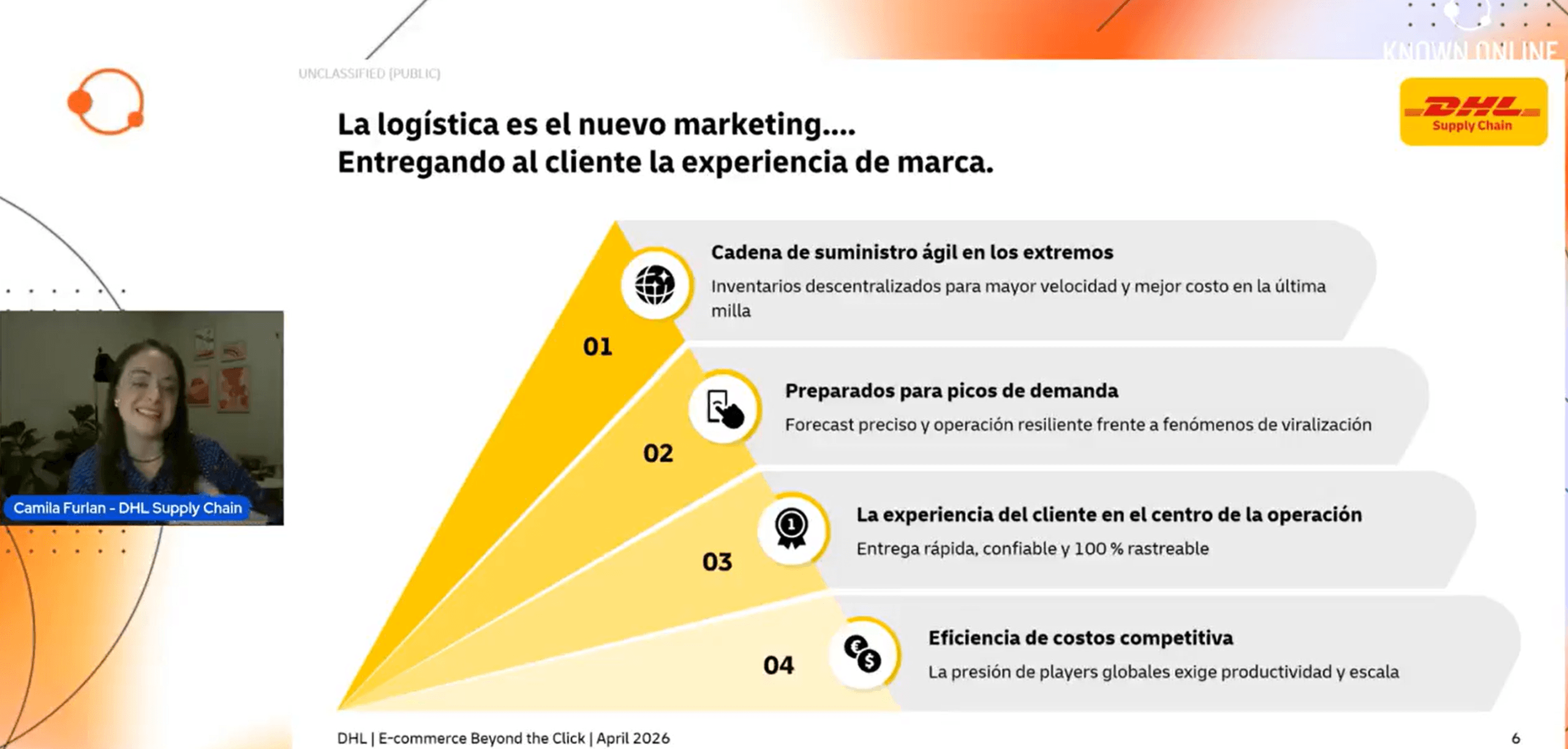
- Agentic Commerce (AI agents that discover, purchase, and await delivery) → requires logistics to literally become the new marketing.
- From niche to mass market → requires a more sophisticated returns management system.
- Segmentation beyond demographics → translates into a better experience and greater profitability.
- Physical stores as meeting places and community hubs → confirms that Latin America remains a key, growing market globally.
The summary of the entire talk could be boiled down to a single sentence that Furlan made very clear: logistics is the new marketing.
Send it to me: 80% of delivery issues aren’t caused by the customer
The presentation with the most hard data in the webinar was the one by Nicolás Justiniano, Co-founder, CRO, and CFO of Envíame (“Hidden Costs in Logistics: How They Affect Margins and How to Address Them”).
The context: e-commerce is growing, but demand is growing even faster. E-commerce penetration as a percentage of total retail sales, by country:
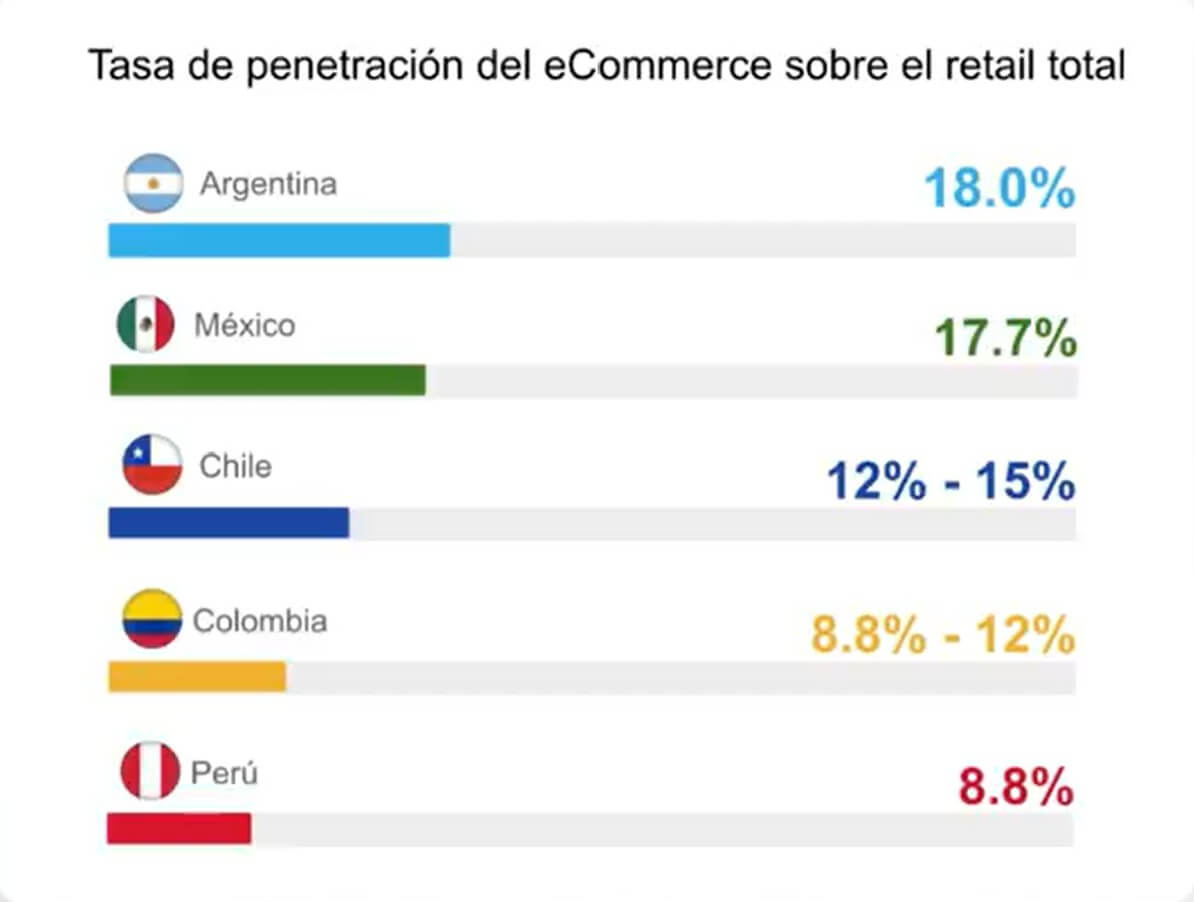
That growth is not accompanied by a commensurate logistics infrastructure: “Logistics is an imperfect world; there’s no such thing as an incident-free operation.” The last mile is the most expensive and least controllable part of logistics costs, and the more e-commerce grows, the more complex it becomes.
The true scale of the problem, according to data from Parcel Perform (Q4 2025):
- 1 in 10 orders has at least one delivery issue: delay, failed delivery attempt, damage, or return.
- 80% of these incidents are carrier-related (assignment, routing, failed delivery attempts, logistics returns).
- Only 20% are due to data errors or incorrect customer addresses.
Most of the friction isn’t caused by what the customer did wrong during checkout, but rather by the logistics provider’s performance.
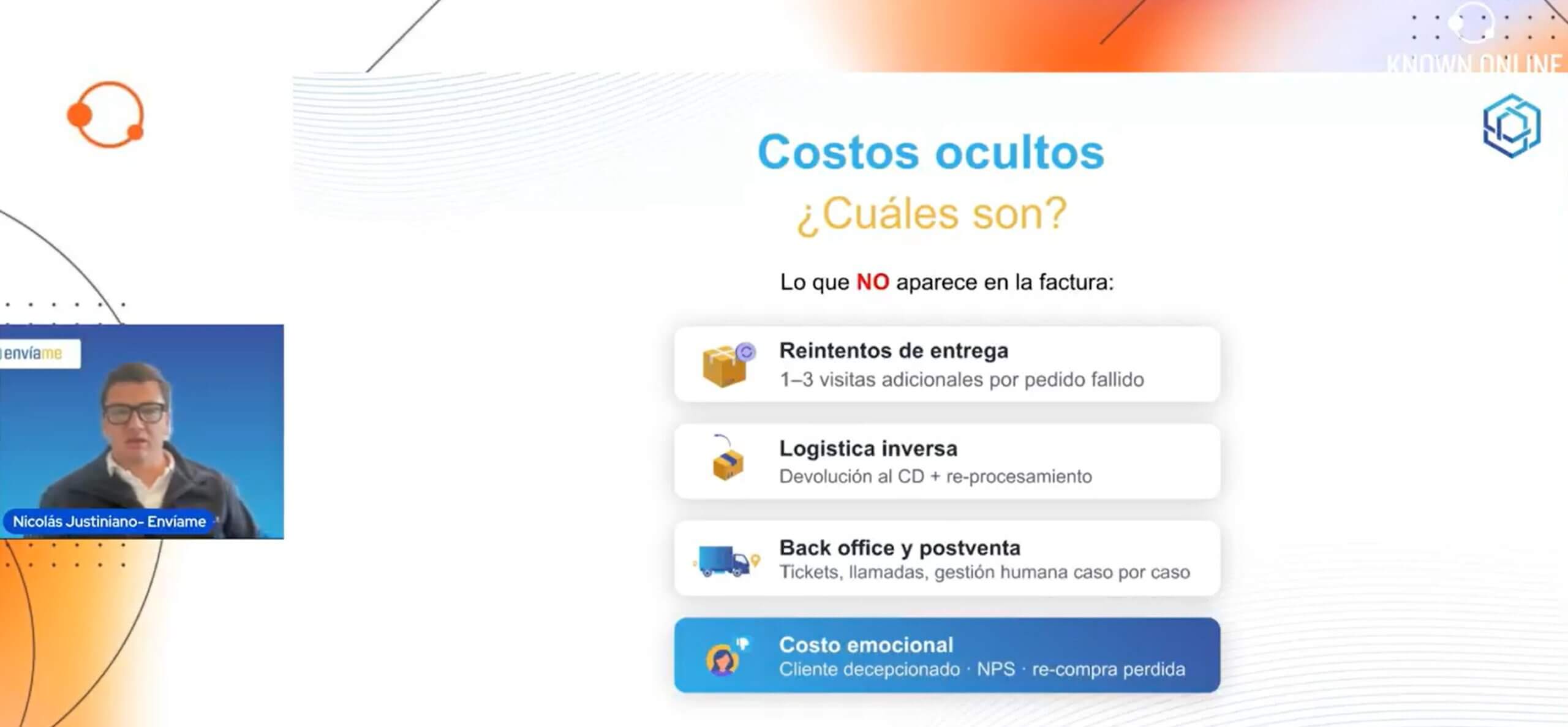
Costs that don’t appear on the invoice. Four hidden costs that are rarely accounted for as part of the cost of service:
- Delivery retries: 1 to 3 additional attempts per failed order.
- Reverse logistics: return to the distribution center plus reprocessing.
- Back office and after-sales: tickets, calls, and case-by-case customer support.
- Emotional cost: a disappointed customer who won’t buy again.
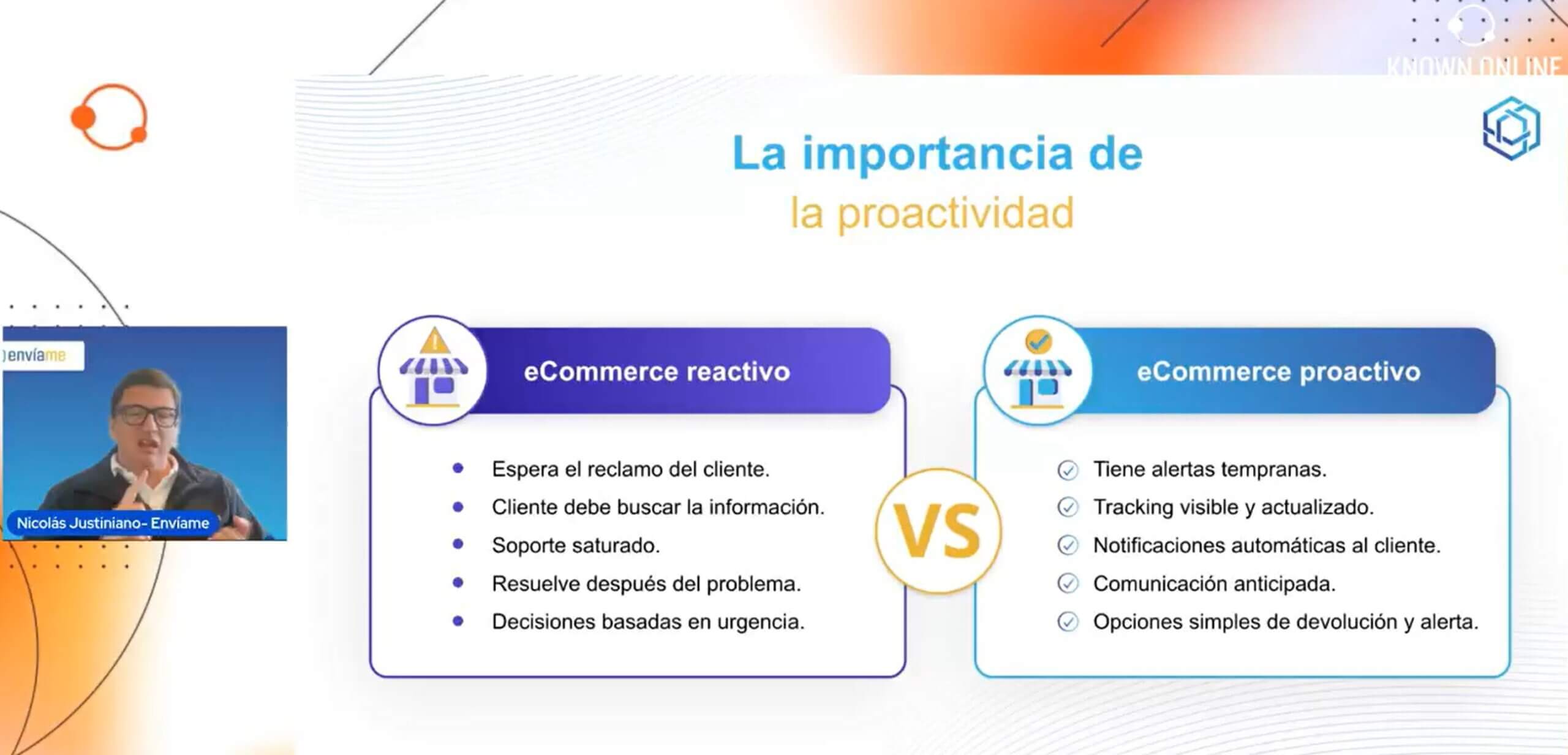
From reactive to proactive. Two contrasting operating models:
- Reactive e-commerce: waits for customer complaints, forces customers to search for information, overwhelms its support team, and resolves issues only after they have already occurred—with decisions made under pressure.
- Proactive e-commerce: operates with early warnings, visible and up-to-date tracking, automatic notifications, and proactive communication.
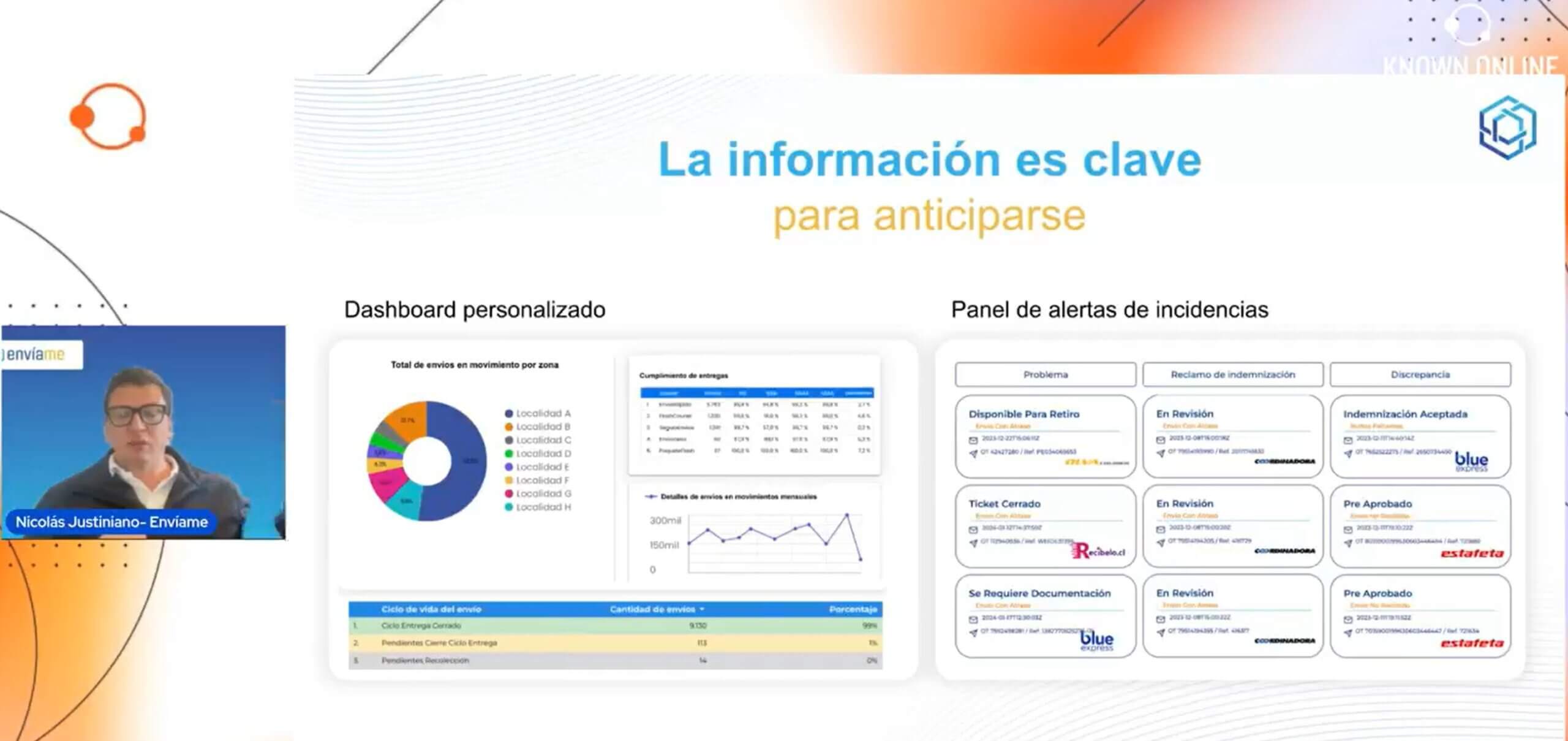
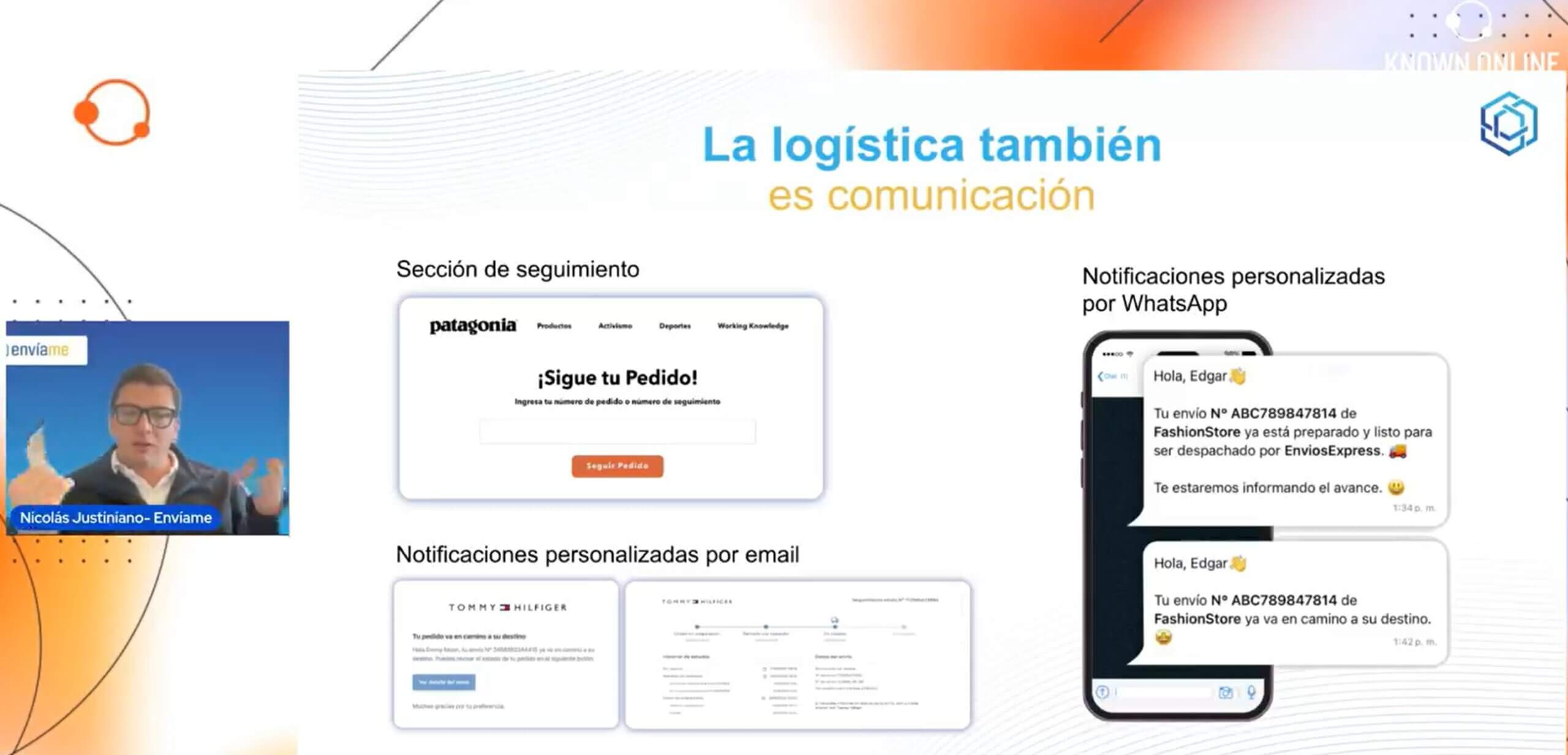
The impact of this change, as measured on platforms such as WhatsApp, is striking:
- 98% read rate.
- Opens in less than 3 minutes.
- Resolutions up to 8 times faster than traditional channels.
Three important lessons:
- Incidents will always happen.
- The real cost isn’t the issue itself, but the trust that’s lost when the customer experiences it without support.
- What determines the outcome isn’t avoiding 100% of problems, but how processes are designed to maintain a positive experience when they do occur.
Ultimately, the post-purchase experience is what drives repeat purchases: delivery, experience, trust, and repeat purchases are all part of the same continuum—not isolated stages of the funnel.
Pickit: Connecting the First and Last Mile in a Single Ecosystem
Sayuri Rodríguez, Commercial Director at Pickit, offered a complementary perspective: much of the logistical inefficiency in Latin America stems from the disconnect between the first mile (how the product leaves the distribution center or the seller) and the final delivery, not just in the last mile itself.
Pickit by the Numbers:
- Operations in Argentina (headquarters), Chile, Uruguay, Colombia, Peru, and Mexico.
- More than 1.8 million shipments handled.
- More than 180 professionals in the regional operation.
The entire workflow in a single chain: warehousing with real-time inventory tracking → order receipt (from our own warehouse or a Pickit location) → picking & packing → cross-docking and shipping → final distribution (in-store pickup, home delivery, or same-day delivery).
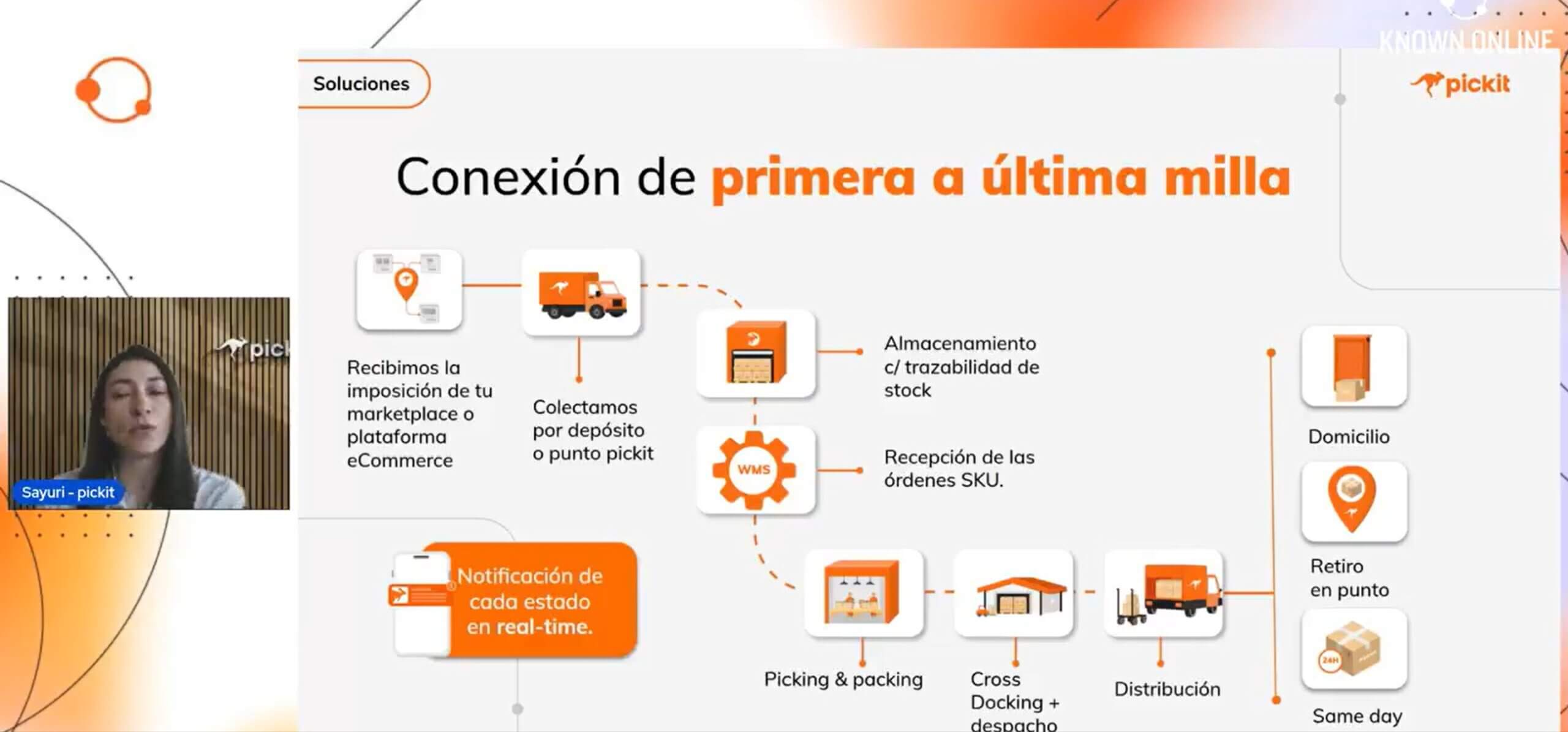
The results, in numbers. Using artificial intelligence, Pickit automates and optimizes these processes, providing better visibility in tracking and a more efficient experience for the buyer.
- Operational results: 99% effectiveness and 98% SLA compliance.
- Customer experience results: Seller NPS of 16.4, first response in 38 seconds, resolution in 72 hours —significantly faster than the unmanaged industry standard.
The underlying message: cost and experience are no longer at odds with each other when the first and last miles are managed as a single system, rather than as independent providers that coordinate only on an ad hoc basis.
Janis Commerce: Why Cutting Costs Isn’t the Same as Gaining Efficiency
Norberto Cerasale, Nearbound Sales Manager at Janis Commerce, delivered the most thought-provoking talk of the webinar from a financial perspective: a real-world case study demonstrating that cost-cutting alone has very limited potential if it isn’t accompanied by effective operational coordination.
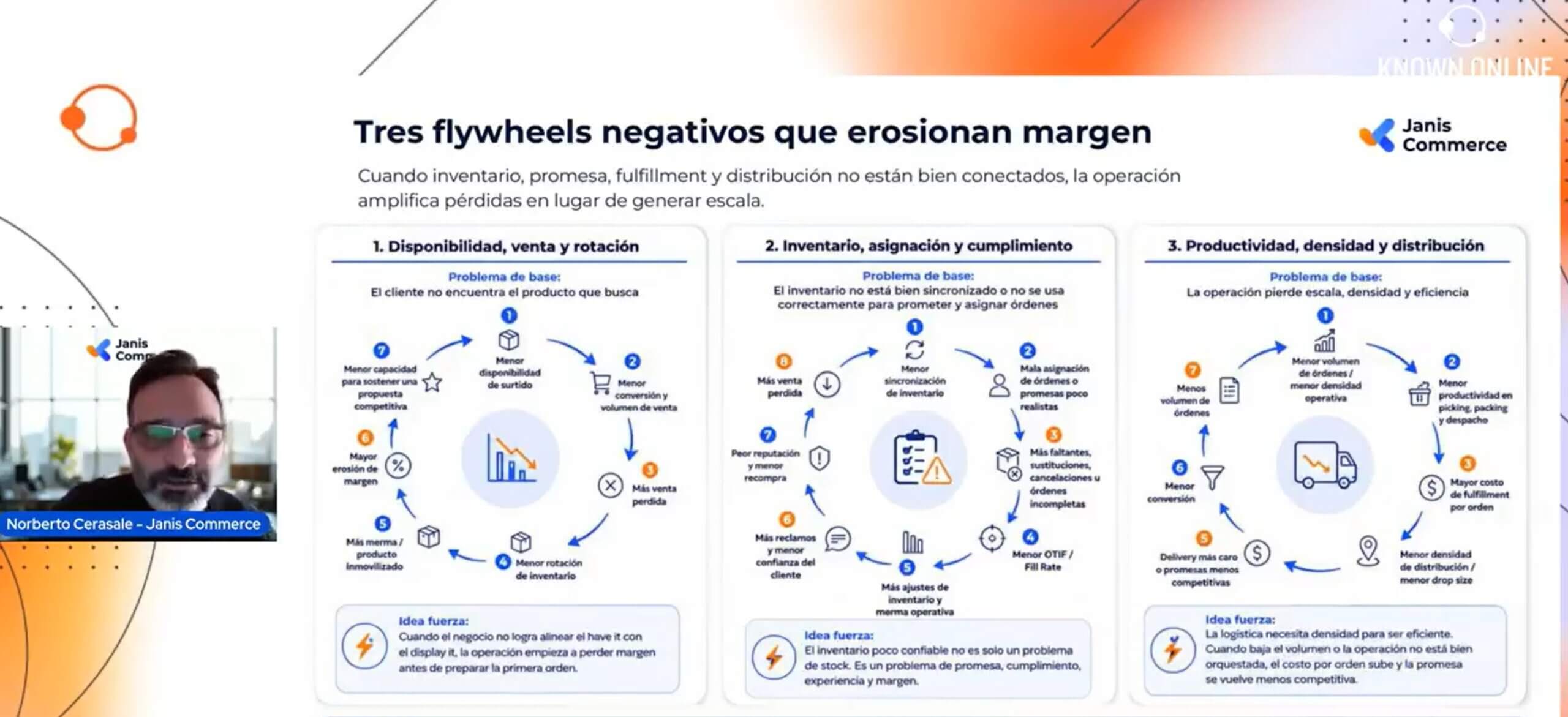
The diagnosis: three negative flywheels that erode margins. When inventory, delivery promises, fulfillment, and distribution aren’t well connected, operations don’t stabilize—they amplify losses instead of driving scale.
- Availability, Sales, and Turnover: The customer cannot find the product they are looking for because inventory is not properly synchronized to fulfill and allocate orders.
- Inventory, allocation, and fulfillment: Inventory is not properly synchronized or is simply not used as a single source of truth.
- Productivity, density, and distribution: The operation loses scale, density, and efficiency, and order quality deteriorates due to the accumulation of operational friction at each step.
The case that brings it to life. An actual 2026 operating income statement showing how a retail business, facing margin pressure, implemented a cost-cutting plan against its budget:
- Staff: -20%
- Outsourced: -40%
- Distribution costs: -7.14%
- Pickup costs: -16.67%
- Delivery costs: -9.09%
- Total expenses: -15.96%
A figure that, at first glance, appears to be a victory for efficiency. The problem is what happened on the other side of the income statement: sales fell 14.29% compared to the budget for the same period. Cerasale’s conclusion was key: “The operation reduces expenses and achieves slight leverage, but it is insufficient in the face of the drop in sales”.
Three lessons from this case, which apply to any CFO reviewing their own P&L:
- Sales targets are not met: actual demand falls short of expectations, and the scale is insufficient to better absorb the operating structure.
- Expenses fall more than sales, but it’s not enough: OPEX is cut and expenses decline, yet the resulting leverage does not offset the drop in revenue.
- Leverage is limited: the improvement is marginal because part ofthe cut begins to affect the minimum levels necessary for operations, reducing flexibility and future responsiveness.
The Unified Commerce Strategy, in 4 Levels. Cerasale outlined the comprehensive framework that structures the entire presentation: 4 levels for turning the delivery promise into a profitable and consistent operation, each addressing a different business question:
- Unified Commerce: Define the value proposition, the desired customer experience, and the channels for capturing demand (channels, value proposition, purchase journey, omnichannel architecture, interoperability). What expectations do we want to create in the customer?
- Fulfillment and distribution network: defines the structural capacity to fulfill the promise: nodes, inventory, coverage, and delivery methods (distribution centers, stores, dark stores, inventory per node, coverage, carriers). What network will we use to fulfill that promise?
- Orchestration layer: converts network capacity into operational, fulfillable, and profitable commitments (actual availability, node allocation, capacity, business rules, delivery promise, exceptions). As Cerasale pointed out, “It’s not just technology: it’s standardization, consistency, parameterized flexibility, and improved operational variability.” What should be promised, and how should each order be fulfilled?
- Perfect Order Fulfillment: Activates operational workflows to deliver on the promise with speed, accuracy, and traceability (picking, packing, quality checks, shipping, delivery, claims, and returns). How do we turn the promise into a perfect order without sacrificing profit margins?
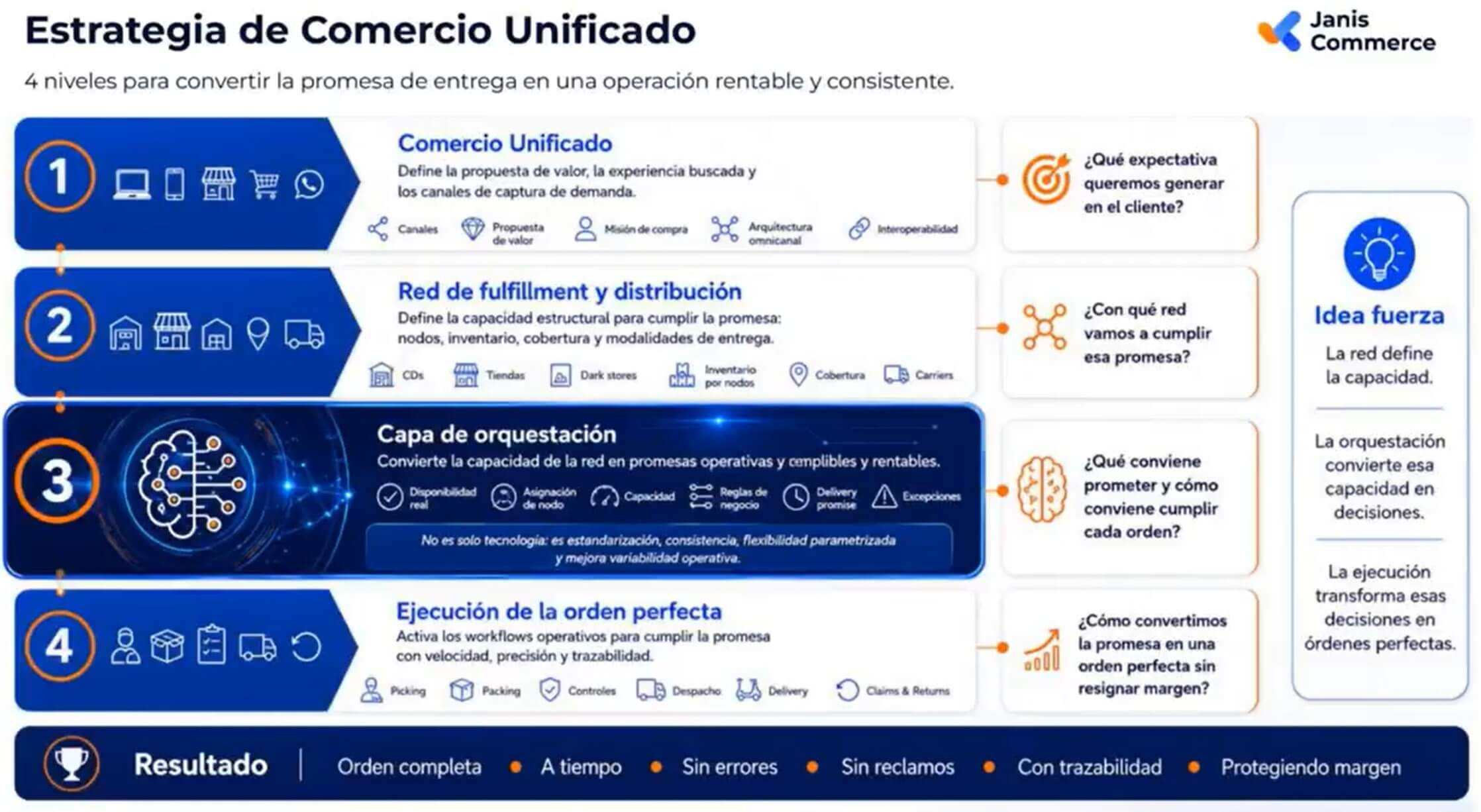
Janis Commerce’s solution isn’t to cut back further—it’s to orchestrate: a unified commerce platform—which explicitly defines itself as “much more than an OMS”—that makes smart, real-time decisions about inventory, proximity, costs, and sustainability, and automates order allocation to support various shopping scenarios (click-and-collect, home delivery, in-store pickup, returns) on a single operational platform. The key idea: intelligent orchestration breaks these negative cycles by connecting inventory, capacity, promises, and execution—something that cost-cutting, no matter how aggressive, cannot achieve on its own.
Paquery: Maintaining Same-Day Service Without Compromising Profitability
To wrap up the webinar, Cinthia Benavides, Operations Manager at Paquery Ecuador, addressed the challenge facing every e-commerce head in the region today: how to deliver on promises of fast delivery without sacrificing profitability?
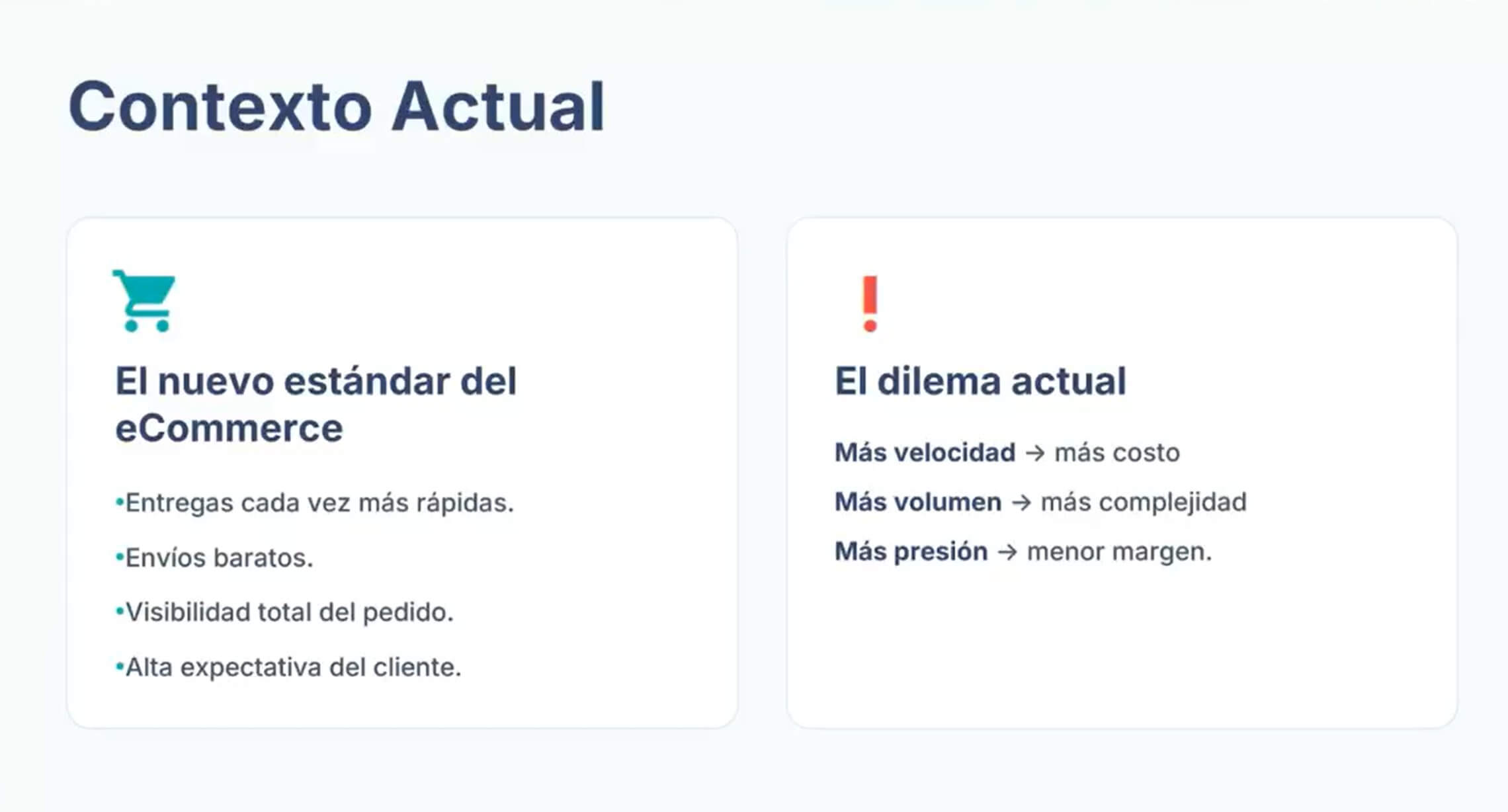
The current context presents a business dilemma rather than a technical problem. The new e-commerce standard demands increasingly faster deliveries, low-cost shipping, full order visibility, and ever-higher customer expectations. The dilemma:
- Higher speed → higher cost.
- More volume → more complexity.
- More pressure on shipping costs → lower margin.
Structural failures and their direct impact on the business. Three recurring root causes: poor planning, lack of visibility, and unrealistic promises made by the sales team without validating actual operational capacity. These failures have a direct impact on the business:
- Margin erosion: inefficient operating costs that eat into profitability per order.
- Increase in complaints: these overload the support team.
- Poor customer experience: failures to deliver that damage brand perception.
- Loss of repeat business: A dissatisfied customer is unlikely to choose the service again.
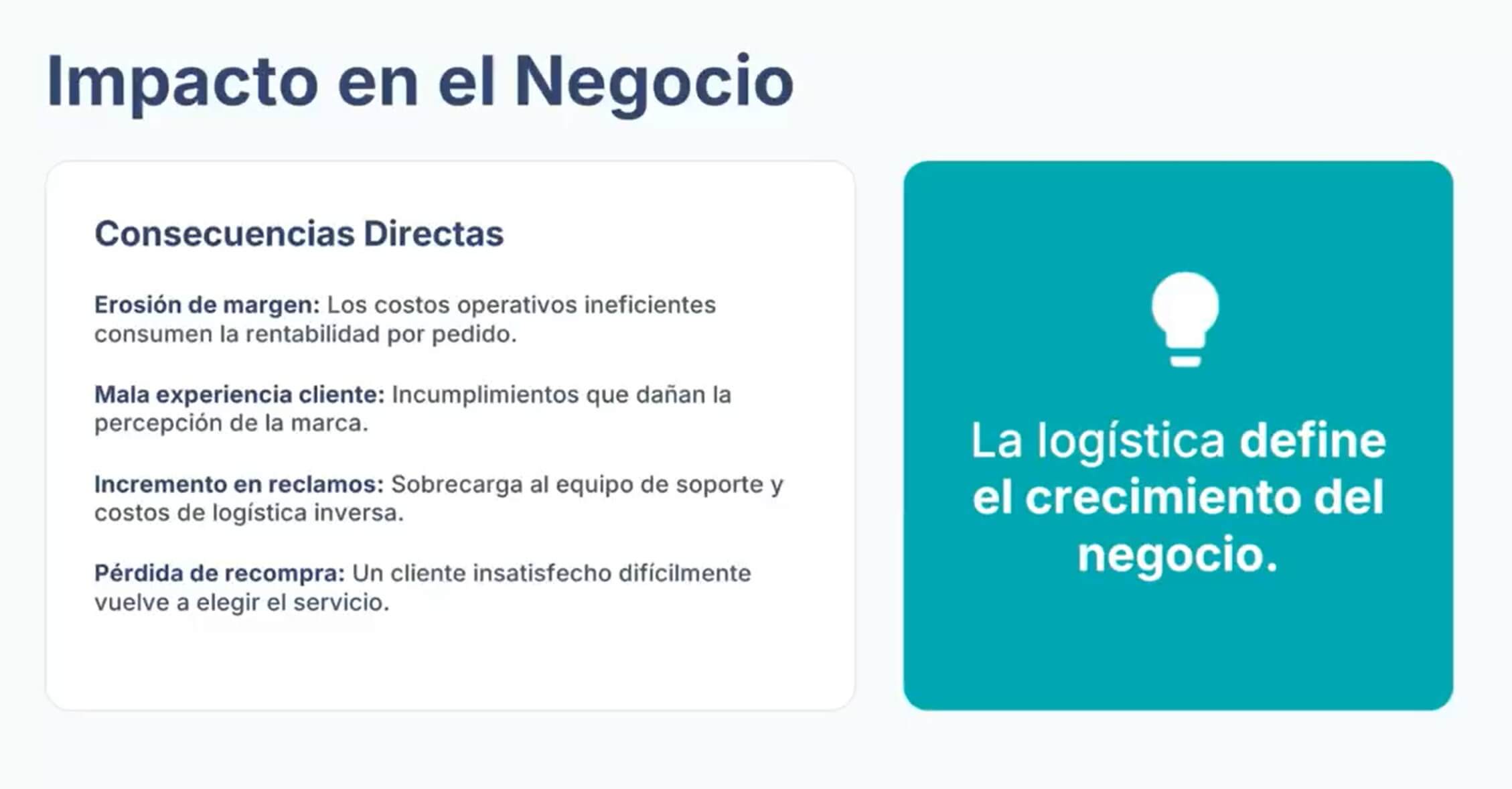
Benavides’ take was straightforward: logistics define brand perception, and operational efficiency is the real competitive advantage.
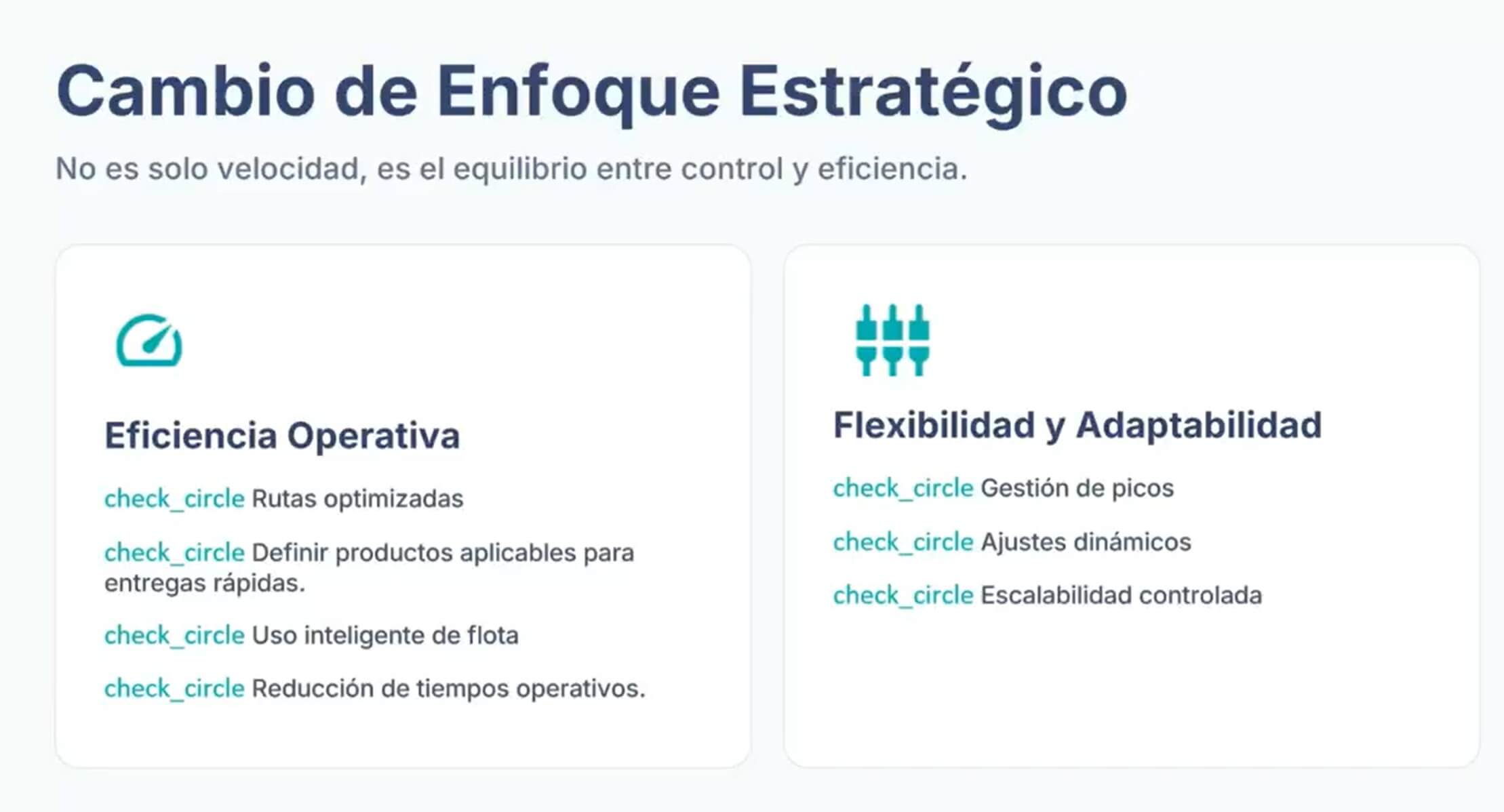
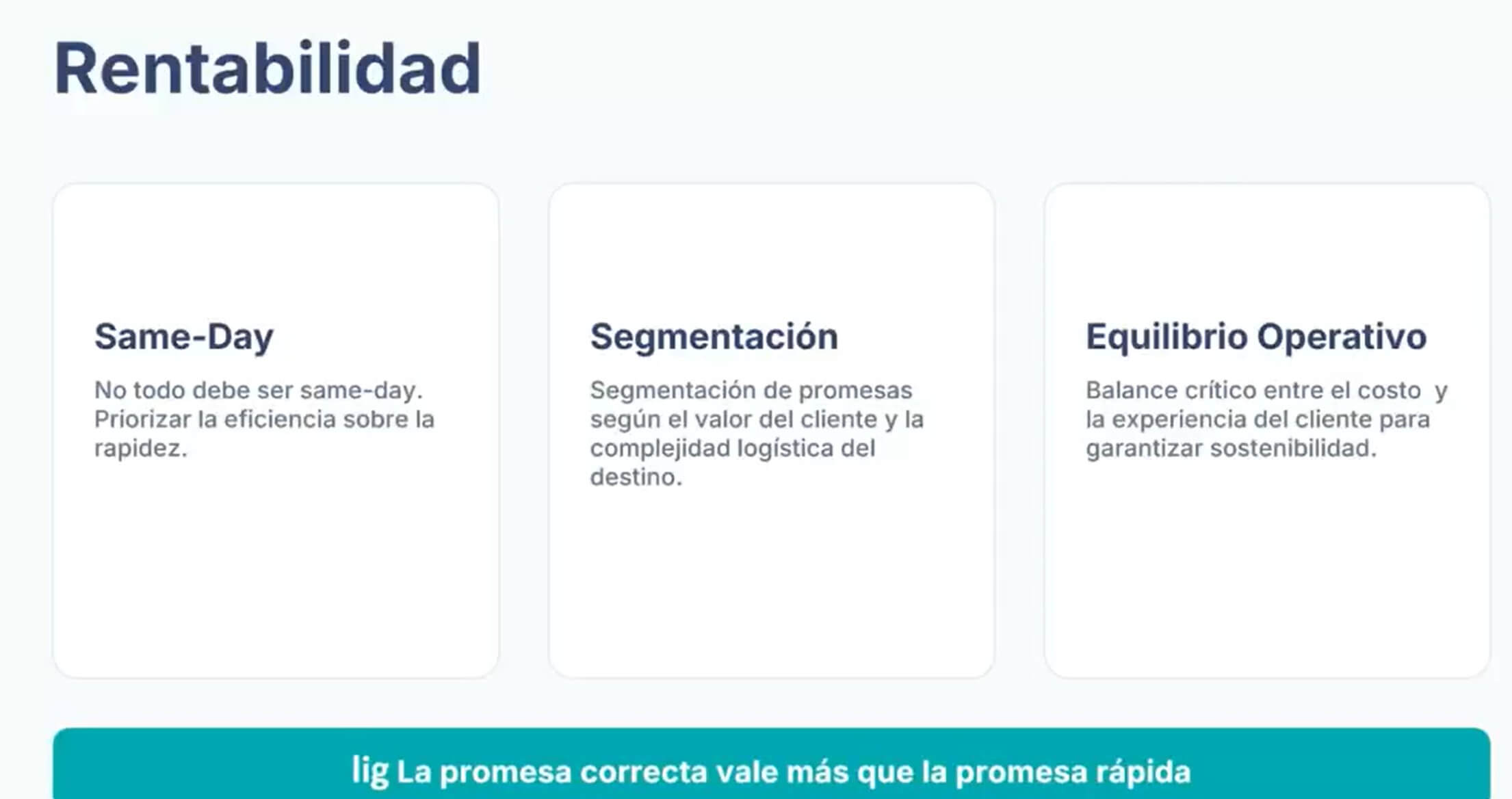
The shift in focus: not every order needs to be same-day. Paquery’s approach is not to promise speed at any cost, but to prioritize efficiency over speed based on customer value and the actual logistical complexity of each area—segmenting delivery promises rather than offering a universal same-day option. As Benavides put it: “It’s not just about speed; it’s about the balance between control and efficiency, ” and “the right promise is worth more than a fast promise.”
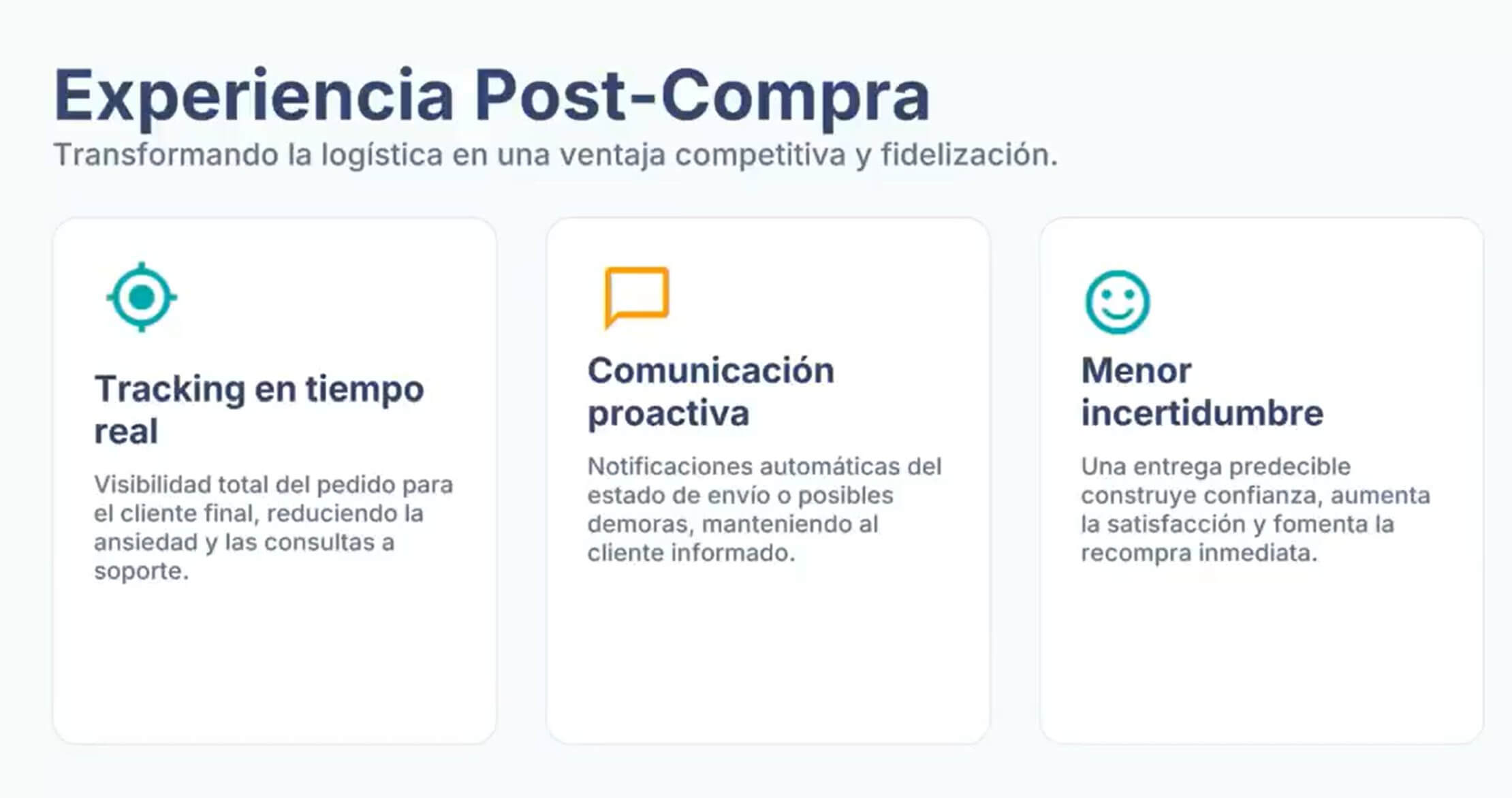
The post-purchase experience as a retention driver. Real-time tracking, automatic notifications about shipment status or potential delays, and full order visibility directly reduce customer anxiety and the burden on customer support. Proactive communication isn’t just a courtesy—it builds trust, increases satisfaction, and encourages immediate repeat purchases.
Profitable Same-Day Delivery: The Checklist. Non-negotiable conditions to ensure speed doesn’t erode margins:
- Determine which products are eligible for same-day delivery.
- Dynamic adjustments based on demand.
- Peak management.
- Controlled scalability.
- Smart fleet utilization.
- Optimized routes.
- Reduced operating times.
The Quito & Guayaquil Case. To wrap up, Benavides shared a real-life example of Operation Flex involving the two cities.
- The challenge: poorly optimized routes by area, high reverse logistics costs, volume growth that the operation couldn’t keep up with, and increasingly high customer expectations.
- The solution: coordinating retailers in different areas through consolidated pickups, package consolidation, and optimized routes.
- The results: sustained high volume, reduced delivery times, greater operational efficiency, a better customer experience, and an SLA exceeding 98%, with the ability to scale without compromising it thanks to technological integration among the parties.
Benavides emphasized that volume is sustainable only when backed by operational discipline. The conclusion of the talk—and of the entire webinar—boiled down to a single point: whoever controls their operation controls their growth.
E-commerce Logistics in Latin America: The Logistics have evolved from a support function to a margin driver
Five companies, five different perspectives (omnichannel, last mile, first mile, unified commerce orchestration, same-day delivery), and one underlying conclusion: conversion doesn’t end at checkout. It ends when the order arrives—and when the customer trusts the brand enough to make another purchase.
For any Sales Director or e-commerce Manager who continues to measure their operation by CAC and ROAS, the webinar raises an even more uncomfortable—and more precise—question: How much of the margin you think you’re losing on customer acquisition is actually being lost after the purchase click—in delivery retries, reverse logistics, cost-cutting measures that fall short, and customers who don’t return because no one notified them in time?
This article summarizes the key points, but each talk includes much more detail than can be covered in an article: case studies, questions from the audience, and the discussion among the five speakers. You can watch the full webinar—featuring all five talks and the Q&A session—on Known Online’s LinkedIn page.
Watch the full webinar on e-commerce logistics in Latin America
Where should you start when reviewing your operations?
In our conversations with e-commerce and operations teams, one pattern emerges time and again: there are opportunities for improvement—with a direct impact on margins, customer experience, and operational efficiency—that remain hidden amid day-to-day management, including logistics costs that are difficult to absorb, friction points that affect the shopping experience, and operational growth that isn’t accompanied by greater efficiency.
That’s where we’re helping various companies in the region: by identifying specific opportunities for improvement that have a real impact on conversion rates, user experience, and profitability. On our Logistics Solutions page , we explain how we integrate WMS, last-mile delivery, fleet management systems, fulfillment providers, and OMS with the e-commerce platform, and you can see case studies of clients with whom we’ve already done this work.
If you’re interested in reviewing your own situation, please fill out the form, and we’ll coordinate with our sales team to work with you to determine where to start.