


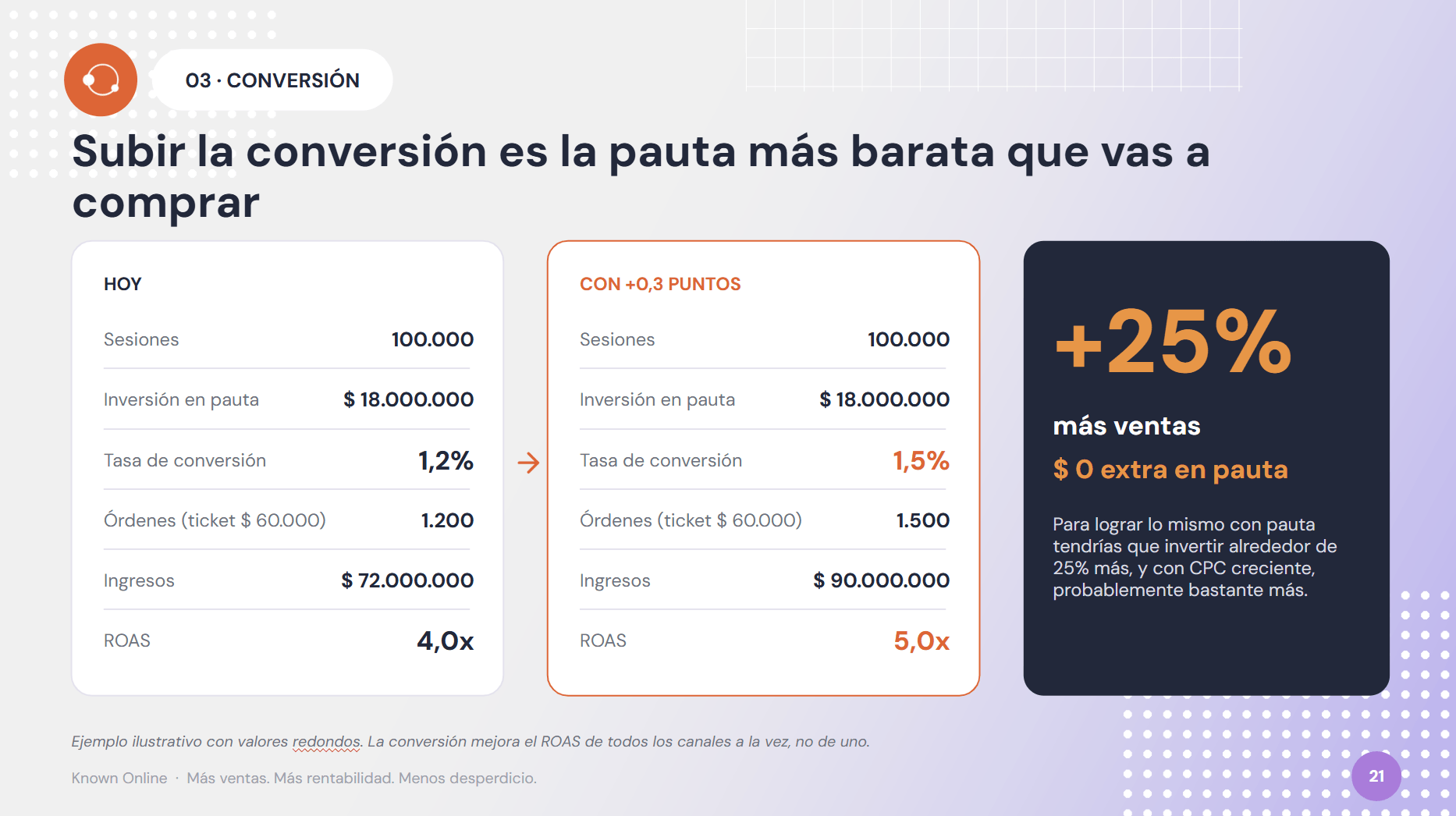
3 quick wins to convert the click you’ve already paid for: show the total cost before checkout, remove friction from the checkout process, and make your site’s search feature drive sales. Increasing the conversion rate from 1.2% to 1.5% generates 25% more sales with the same advertising budget. To achieve the same results by buying traffic, you’d have to invest about 25% more—and with CPCs on the rise, probably quite a bit more. With that as a starting point, Ariel Bortz, Chief Operating Officer of Known Online, It was featured in our webinar “More sales. More profitability. Less waste“The Conversion Block: How to Do It” CRO for e-commerce and to better convert the traffic you’re already paying for.
CRO for E-commerce: Apparent ROAS and Actual ROAS
A high CTR and an efficient CPC are useless if the site doesn’t convert. In the example shown, with the same number of sessions and the same budget, increasing the conversion rate by 0.3 points raises the ROAS from 4.0x to 5.0x, without spending a single extra peso on ads.
Conversion improves the ROAS across all channels simultaneously, not just one. If done right, it also improves the POAS—that is, the profit per peso invested.
Why 7 out of 10 Shopping Carts Don’t Result in a Purchase
According to the Baymard Institute, the average shopping cart abandonment rate is 70.22%. This figure is based on users who actually started a shopping cart, not on the total number of sessions. The main reasons are:
- Extra costs such as shipping, taxes, or fees (39%).
- Shipping is too slow (21%).
- Reluctance to enter credit card information (19%).
- Requirement to create an account (19%).
- Long or complicated checkout process (18%).
- Unclear return policy (15%).
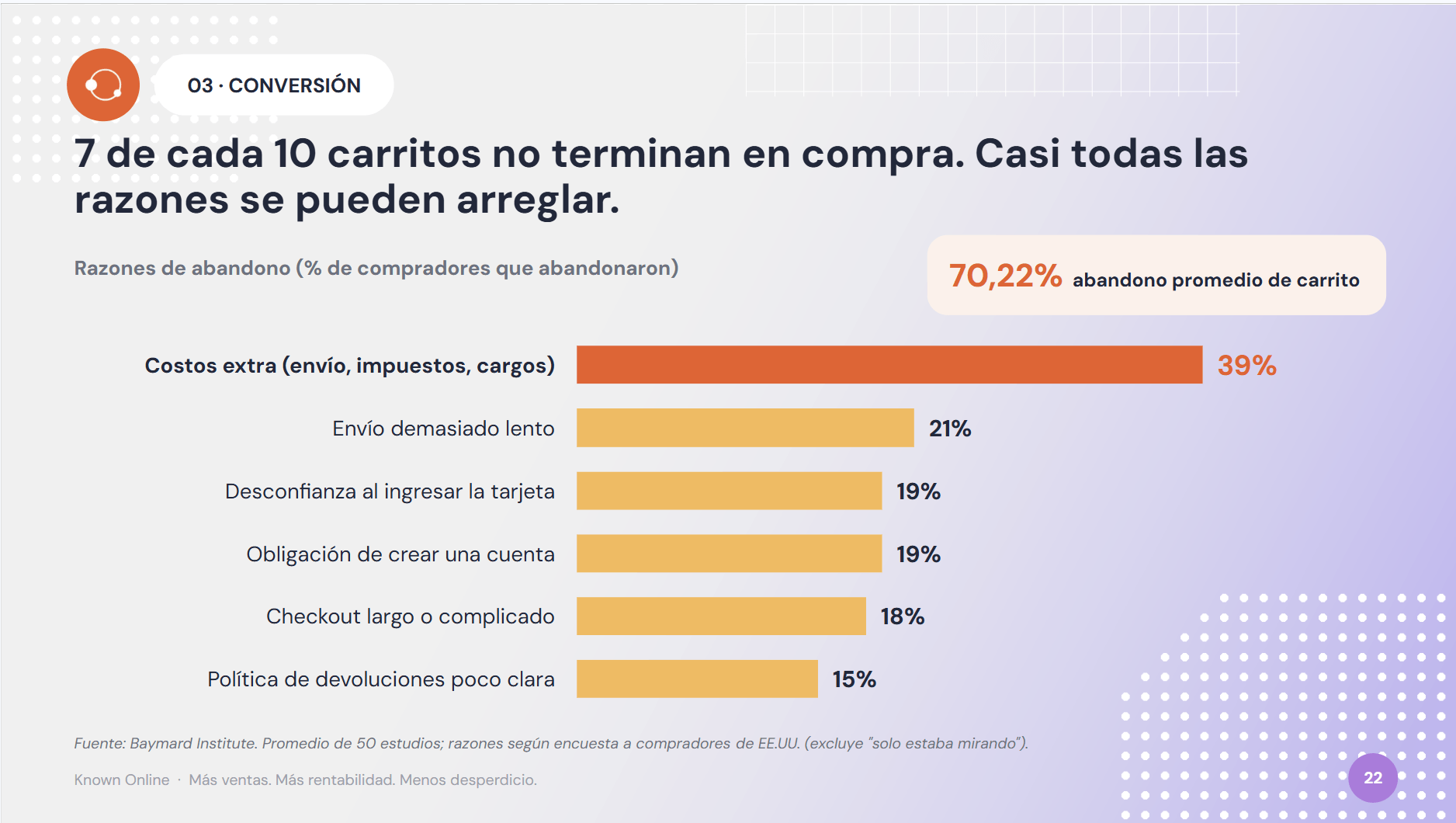
When it comes to extra costs, people know they’re going to have to pay them. The problem is that they find out at the end of the process—or in a way that’s unclear. Almost all of these issues can be addressed through user experience (UX/UI) decisions.
Quick Win 01 · Total cost visible before checkout
Low effort · High impact
- Display the estimated shipping cost by ZIP code on the product page.
- List the fees and final price using local payment methods.
- Ensure there are no surprises in the final step.
With AI, you can offer assisted sales without the cost of having a person sit in front of a screen—a model that’s expensive and doesn’t scale well. At Known Online , we developed ChatFlow AI, an assistant that integrates catalog, operational, order, and customer data into a single repository. It answers questions about shipping, exchanges, and payment plans, recommends products, and also assists human sales representatives. The key metric is the conversion rate from cart to checkout.
Quick Win 02 · Frictionless Checkout
Medium effort · High impact
- Enable guest checkout.
- Use address autocomplete and ask for only the minimum required fields.
- Display digital wallets and local payment methods prominently.
These are best practices that have been around for years, but we still see sites that don’t implement them. Using AI, we analyze session recordings, pinpoint the exact point where users abandon the process, and classify each session based on the issue detected. We perform CRO on VTEX, Shopify , and Adobe Commerce, measuring conversion at every step of the checkout process.
Quick Win 03 · Internal Search That Drives Sales
Low effort · High impact
- Export searches that don’t return any results.
- Correct them using synonyms, redirects, and product assortment adjustments.
- Add recommendations to the product page and the shopping cart.
There isn’t much more to it than that. AI adds semantic search based on intent and cross-selling based on affinity. With CrossUp, our in-house tool, we cross-reference searches with purchase and browsing history. The result is concrete suggestions: which products to recommend, which synonyms to create, and which redirects to set up. The key metric is the conversion rate of users who use the search bar.
Two AI-powered CRO accelerators
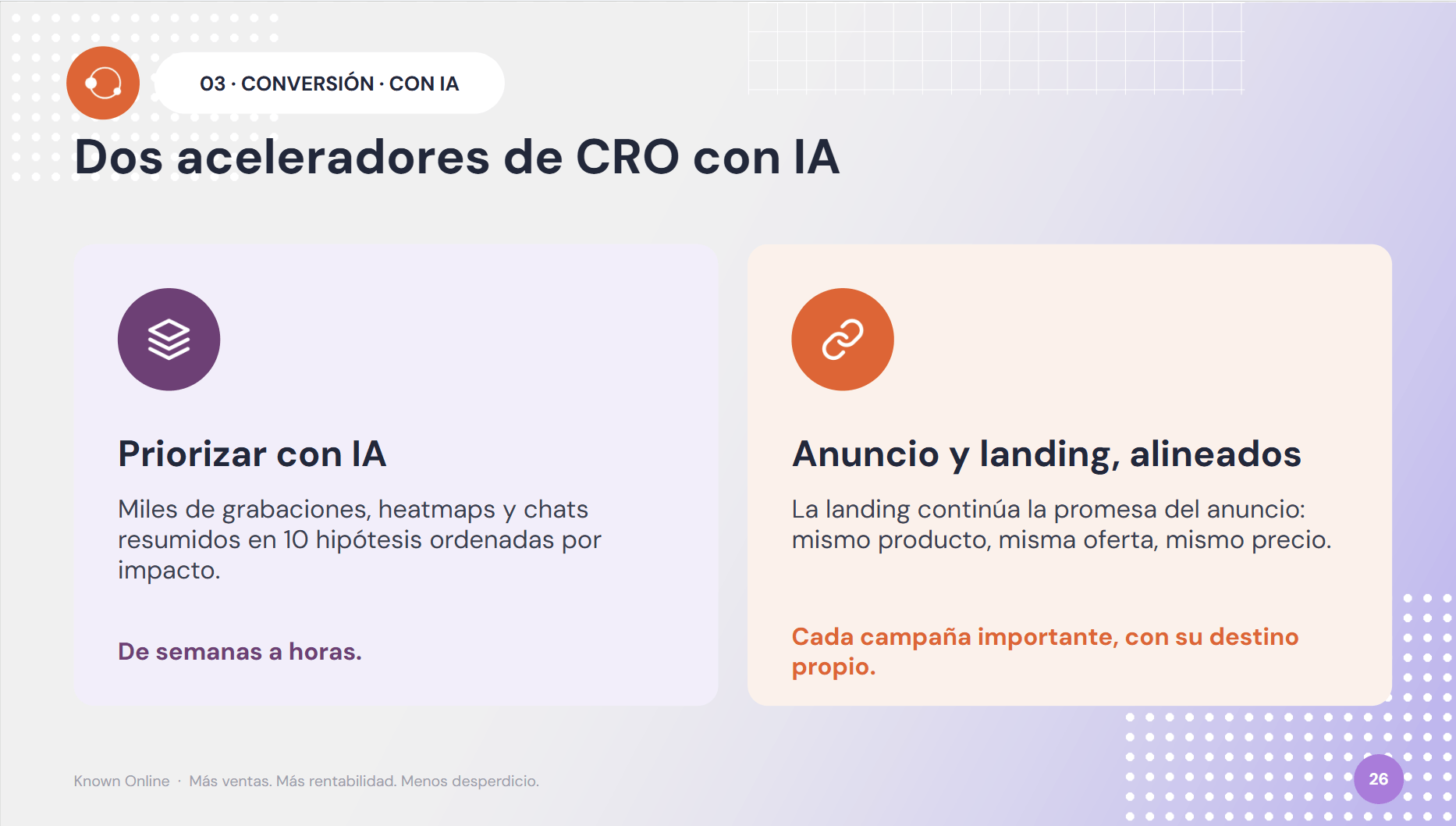
Prioritizing with AI. Thousands of recordings, heatmaps, and chats are summarized into ten hypotheses ranked by impact. That analysis, which used to take weeks of manual work, is now completed in a matter of hours.
Aligned ads and landing pages. The landing page must deliver on the ad’s promise: same product, same offer, and same price. Every major campaign needs its own dedicated landing page. That’s why a significant portion of CRO work is also done at the ad placement stage.
The webinar recording is available here.
At Known Online, we provide CRO services for e-commerce on VTEX, Shopify, and Adobe Commerce, using AI-powered session analytics. Contact us.
Every abandoned shopping cart is a click you’ve already paid for.
Frequently Asked Questions About CRO for E-commerce
Which CRO metrics should you track?
The rate at which users proceed from the shopping cart to checkout, the conversion rate for each step of the checkout process, and the conversion rate for users who use the site search.
Does shopping as a guest reduce cart abandonment?
According to the Baymard Institute, 19% of shoppers who abandon their carts do so because they are required to create an account.
What is semantic search?
It is a search that interprets the intent behind the query, rather than relying solely on exact word matches.
Why does CRO improve all channels at once?
Because it affects the website, which is the same destination for all traffic. An improvement in conversion applies to every visit, regardless of the channel it comes from.