


Nearly 6 out of every 10 searches now end without a click to any website. That was the statistic Ariel Bortz, CEO of Known Online, used to open the webinar on SEO, GEO, and AEO: How to Prepare Your Brand for the New Search Ecosystem.
The question that defines a brand’s visibility today isn’t how many times it appears on Google, but whether the AI model that responds in its place knows enough about it to mention it. This is a comprehensive summary of what was presented—and proof that it works: the results of applying it to real accounts.
Key points from this article on SEO, GEO, and AEO in 2026
- The shift in search behavior: nearly 60% of searches end without a click, 1 in 3 users now starts their search on an LLM rather than on Google, and sessions originating from generative search engines are growing 400% year-over-year.
- SEO, GEO, and AEO are not the same discipline: each search engine measures different signals. Google continues to prioritize backlinks; LLMs prioritize brand mentions and recognized entities; direct answers prioritize schema, freshness, and extractable format.
- The Known Method: the 4 pillars of 2026 search ranking— entity and authority, AI-ready content, off-page signals, and AI measurement—worked on in parallel rather than sequentially.
- The 5 most costly mistakes we’re seeing: from treating GEO as “SEO 2.0” to investing only in links, failing to measure AI presence, or publishing content without a clear thesis.
- Case Study: DTC Brand in Latin America— With the framework implemented in 90 days, the share of voice for key prompts rose from 18% to 61%, organic sessions grew by 42%, and blended CAC fell by 27%.
- 30-, 60-, and 90-Day Plan: The concrete roadmap for moving from an organizational assessment to a system for continuously measuring presence on generative search engines.
Search behavior no longer revolves around clicking
Three facts put the problem into perspective:
- About 60% of searches end without any clicks to a website, thanks to direct answers from Google and featured answers.
- Today,1 in 3 users starts a search on a language model (Perplexity, ChatGPT, Gemini, or Claude) before turning to Google.
- Sessions originating from generative models grew by 400% year-over-year, according to aggregated AI referral sources.
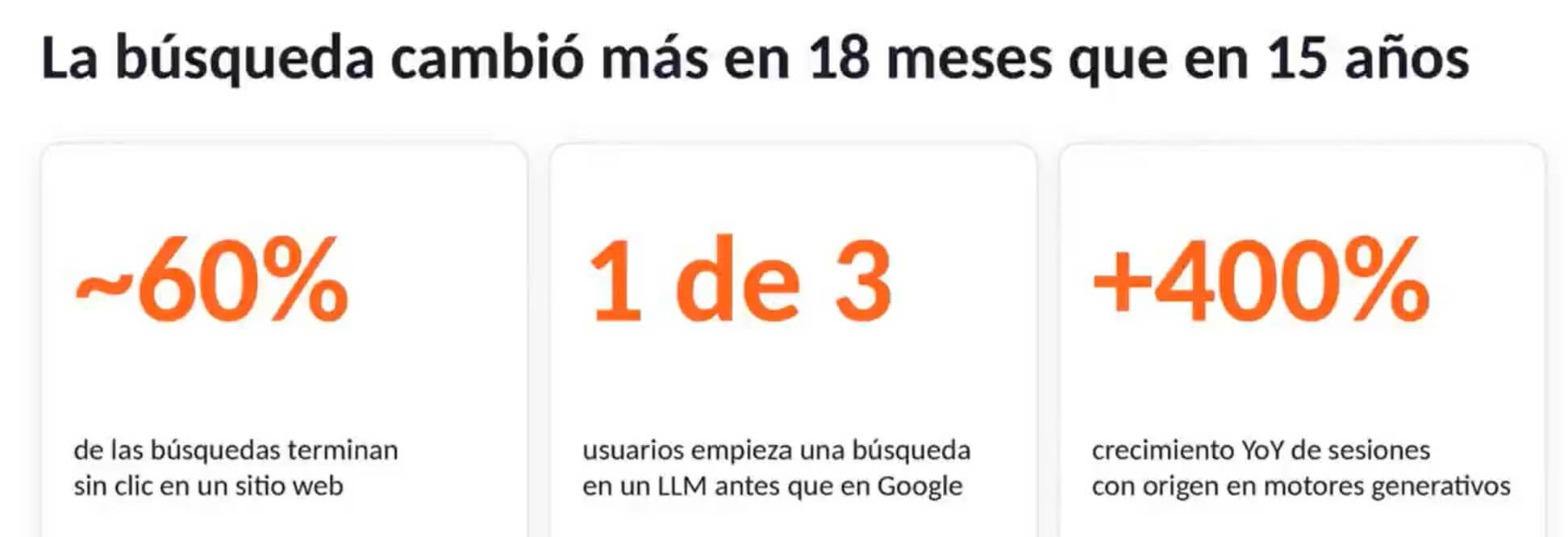
These three figures describe an ecosystem wherea brand no longer competes simply to appear on a list of results. It competes to be the source that a model of AI decides to cite, summarize, or recommend when someone asks about its category.
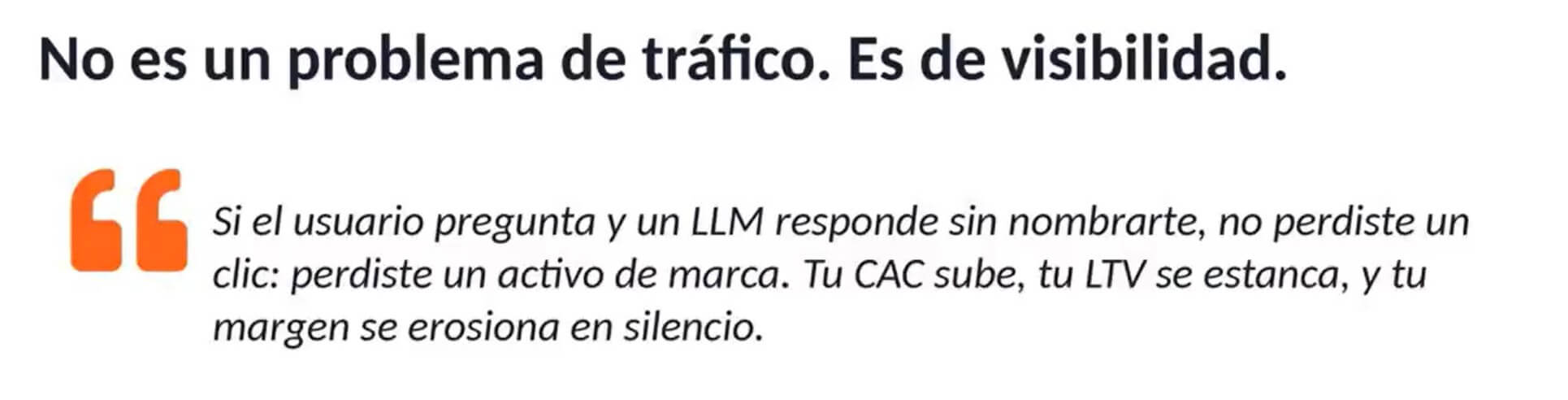
The cost of failing to adapt has three direct consequences for the business: CAC rises because paid advertising now covers what organic traffic used to; share of voice becomes unclear, because the brand doesn’t know if it appears on ChatGPT, Perplexity, or Gemini; and the brand becomes invisible in the medium term, while competitors begin to be cited as references in its place.
SEO, GEO, and AEO are not the same discipline
One of the central points of the talk was to clear up the confusion surrounding the treatment of AI-based search ranking as “SEO 2.0.” They are three distinct games, with different rules, that run in parallel:
- SEO (Search Engine Optimization): Optimizes for traditional search engine rankings on search engines like Google.
- GEO (Generative Engine Optimization): Optimizes so that language models cite your brand as a source.
- AEO (Answer Engine Optimization): Optimizes to secure the direct answer in AI overviews, featured snippets, voice assistants, and in-app responses.
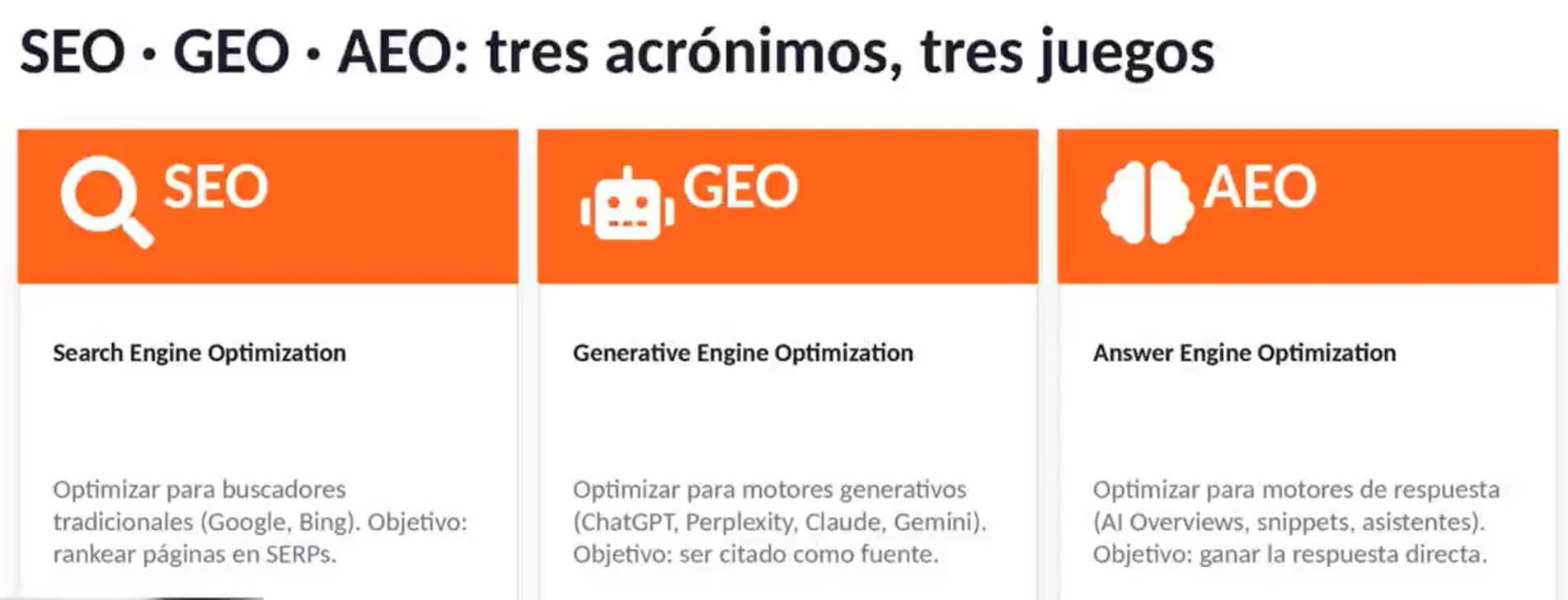
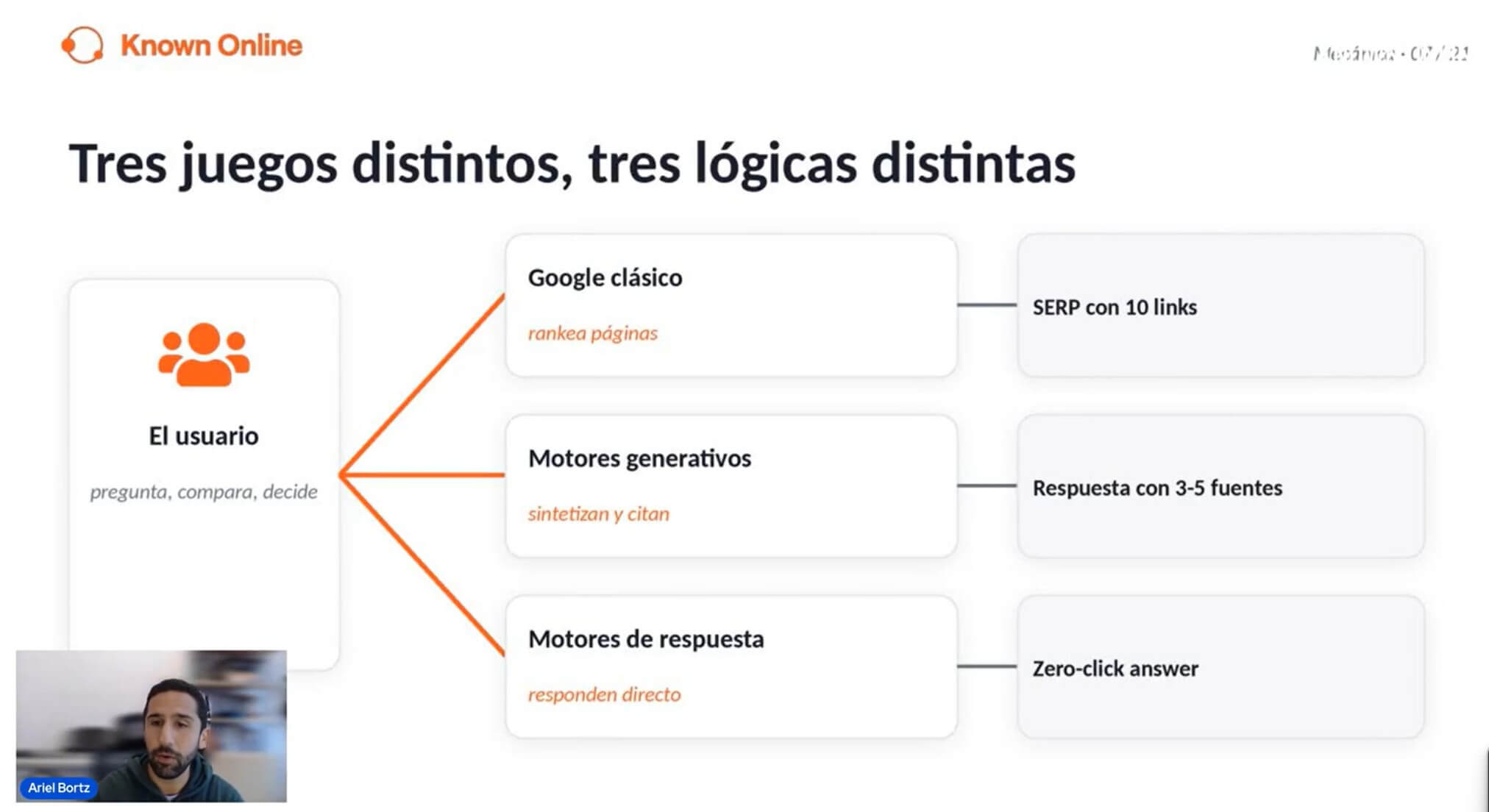
Google continues to prioritize backlinks, but GEO and AEO prioritize brand consistency, content structure, and the freshness of information. Optimizing for only one of the three search engines leaves the brand vulnerable on the other two.
SEO in 2026: What Still Works and What No Longer Cuts It
The first mistake we see in audits is treating a drop in organic traffic as an exclusively technical problem. Before adding new disciplines, you need to separate what’s still relevant in SEO from what’s no longer effective.
Still relevant:
- Intent matching: understanding what the user is really looking for, not just the literal keyword.
- E-E-A-T (experience, expertise, authority, trust): plays an increasingly important role in how search engines evaluate a source.
- Core Web Vitals and technical UX: these remain the foundation of any strategy, not the ceiling.
It’s not enough anymore:
- Keyword stuffing and search volume without intent: LLMs read context, not keyword density.
- Generic content “written for SEO”: if it doesn’t present its own thesis, it won’t be cited or linked to.
- Backlinks as the sole metric: today, brand mentions—with or without a link—in trusted sources matter just as much.
GEO: How to Build the Authority That an AI Model Can Cite
The basic rule of GEO, as outlined in the talk, is that language models don’t rank—they synthesize. They cite sources that are clear, specific, citable, and have consensus on the web. Succeeding with GEO means working on two levels simultaneously: entity (ensuring the model recognizes you as a relevant authority on a topic) and citability (ensuring your content is easy to extract and reuse).
How to Be Cited by ChatGPT, Perplexity, and Gemini: Four specific factors determine this citability:
- Recognized entity: a strong profile on structured sources such as Wikipedia, Crunchbase, and industry-specific directories.
- Citable content: original data, clear definitions, and direct answers in the first few paragraphs of the content.
- Structured data: Implementation of schema.org, FAQ, HowTo, and Article, which provide the model with a ready-to-use summary.
- Freshness and consistency: updates with visible dates and the same core message repeated across trusted channels.
AEO: Winning the Answer When the User Won’t Click
If the user isn’t going to click, the criteria that determine the outcome are different: the goal becomes becoming the answer that gets read. AEO specifically optimizes for Google AI Overviews, featured snippets, voice assistants, and direct answers within apps.

Three practices have the greatest impact:
- Answer at the top: The first paragraph answers the question directly; the explanation and context follow.
- Question architecture: Q&A-style structure with an FAQ format, where each H2 heading is an actual question asked by the user, not a keyword disguised as a headline.
- Tables and bullet points: Comparative formats are better at ranking than continuous text; numbered lists get more snippets.
SEO, GEO, and AEO: What Each Engine Measures—and What It Doesn’t
| Signal | SEO (Classic Google) | GEO (LLMs) | AEO (answers) |
| High-quality backlinks | High | Medium | Medium |
| Brand mentions (without a link) | Low | High | Medium |
| Structured data (schema) | Medium | High | High |
| Concise answer at the beginning | Medium | High | Very high |
| Freshness and Updates | Medium | High | High |
| Entity Authority (Wikipedia, directories) | Medium | Very high | Medium |
Framework Known: The 4 Pillars of SEO, GEO, and AEO Ranking in 2026
Now that we’ve distinguished between SEO, GEO, and AEO, we’ll present the framework we use to organize implementation for retail, fashion, pharmacy, and industrial supplies accounts . These are four pillars that are worked on in parallel, not sequentially. If one is missing, the model falls apart.
Pillar 1 · Entity and Authority
The question that needs to be answered is simple yet uncomfortable: if a model is looking for experts in your category, do you appear among the citable sources? If the answer is no, the problem isn’t with the content—it’s with entity recognition. Specific strategies include an “About” page with structured information (founders, headquarters, milestones), a presence on Wikipedia, Wikidata, and relevant vertical directories; a consistent profile on LinkedIn Company, Crunchbase, and industry sites; identifiable authors with bios and credentials; and the Organization + Person schema implemented on the site.
Axis 2 · AI-Ready Content
The golden rule: Every piece of content must be extractable, citable, and have its own thesis. Extractable means the model can pull out a snippet and use it as-is; citable means you’re worth mentioning as a source. In practice, this translates to a TL;DR at the beginning with the direct answer in 50 words or fewer, H2 headings written as actual questions, original data or benchmarks (if it can’t be cited, don’t use it), and schema plus FAQs plus How-To sections in all content that allows for it.
Axis 3 · Off-page signals and mentions
Here’s one of the most significant paradigm shifts of the entire webinar. Previously, off-page strategy boiled down to acquiring backlinks, with link equity as the central metric. Now, the goal is to build a citable reputation: context and consistency, with or without a link. This involves vertical digital PR in industry media and specialized podcasts, author contributions to bylined columns recognized by both Google and LLMs, proprietary datasets and studies published under a clear license, and an active presence in communities like Reddit and Stack Overflow—where language models draw much of their training data.
Axis 4 · Measurement in AI
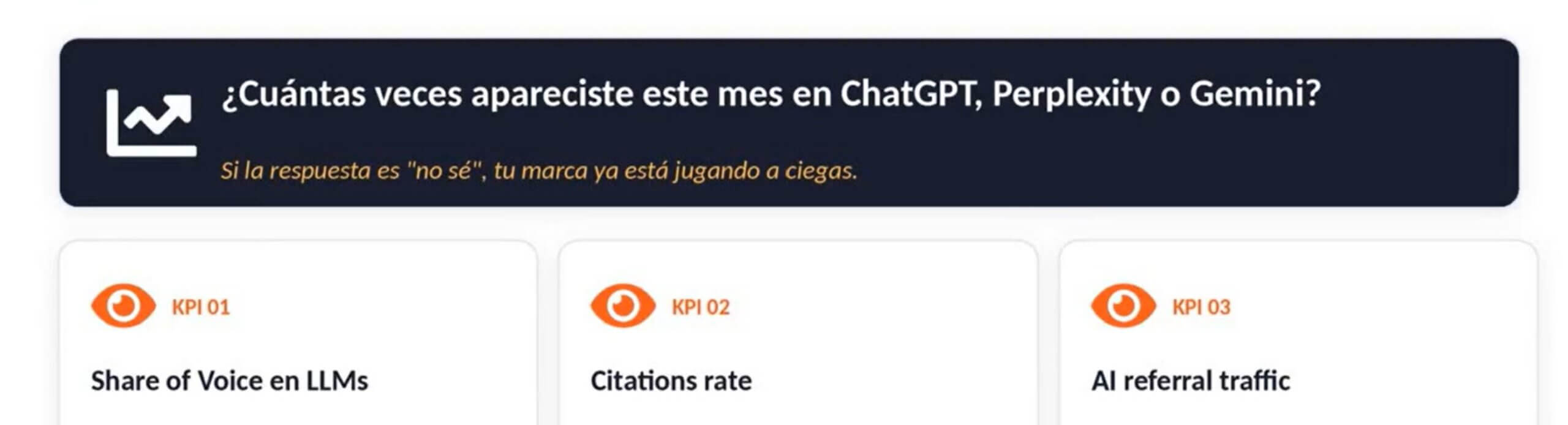
The question that sums up this pillar: How many times did your brand appear this month on ChatGPT, Perplexity, or Gemini? If the answer is “I don’t know,” the brand is already operating blindly on this channel. The three KPIs we track are share of voice in LLMs (based on a list of key prompts, what percentage of the time your brand appears compared to your competitors), citation rate (how many times you’re cited as an explicit source in Perplexity, Gemini, and ChatGPT Search), and AI referral traffic (sessions tagged as coming from AI engines in GA4, as a separate segment from traditional search).
The 5 Most Costly Mistakes We’re Seeing in the Region
During the talk, we shared the mistakes that appear most frequently in the brand assessments we conduct at Known Online for brands that are just starting to look at GEO and AEO:
- Think of GEO as “SEO 2.0”: they are different strategies that run in parallel, not sequentially.
- Investing only in links: Today, unlinked mentions are worth more in GEO than a generic backlink.
- Failing to measure AI presence: without share of voice in LLMs, there’s no way to know if the investment is working.
- TreatingSchema as a formality: poor structured data means the model won’t understand your content.
- Content without a thesis: if the brand doesn’t offer its own unique angle, there’s no reason for it to be cited.
Case Study: DTC Brand in the Construction Sector in Latin America
To illustrate how the framework translates into results, we presented a real-world case study (anonymized due to confidentiality policies) of a DTC brand in the construction sector with a presence in Latin America.
The initial context: stagnant organic traffic, with a 30% drop in CTR since the introduction of Google’s AI Overviews, and a zero share of voice on both ChatGPT and Perplexity for key prompts in its category.
What was implemented in 90 days: simultaneous work on the entity, schema, and rewritten content in a citable format; a plan for mentions in vertical media; and a continuously updated LLM share-of-voice dashboard.
The results:
- +42% in organic sessions compared to the baseline from the previous 90 days.
- Share of voice on key prompts (Perplexity + ChatGPT) increased from 18% to 61%.
- -27% in blended CAC for the digital channel.
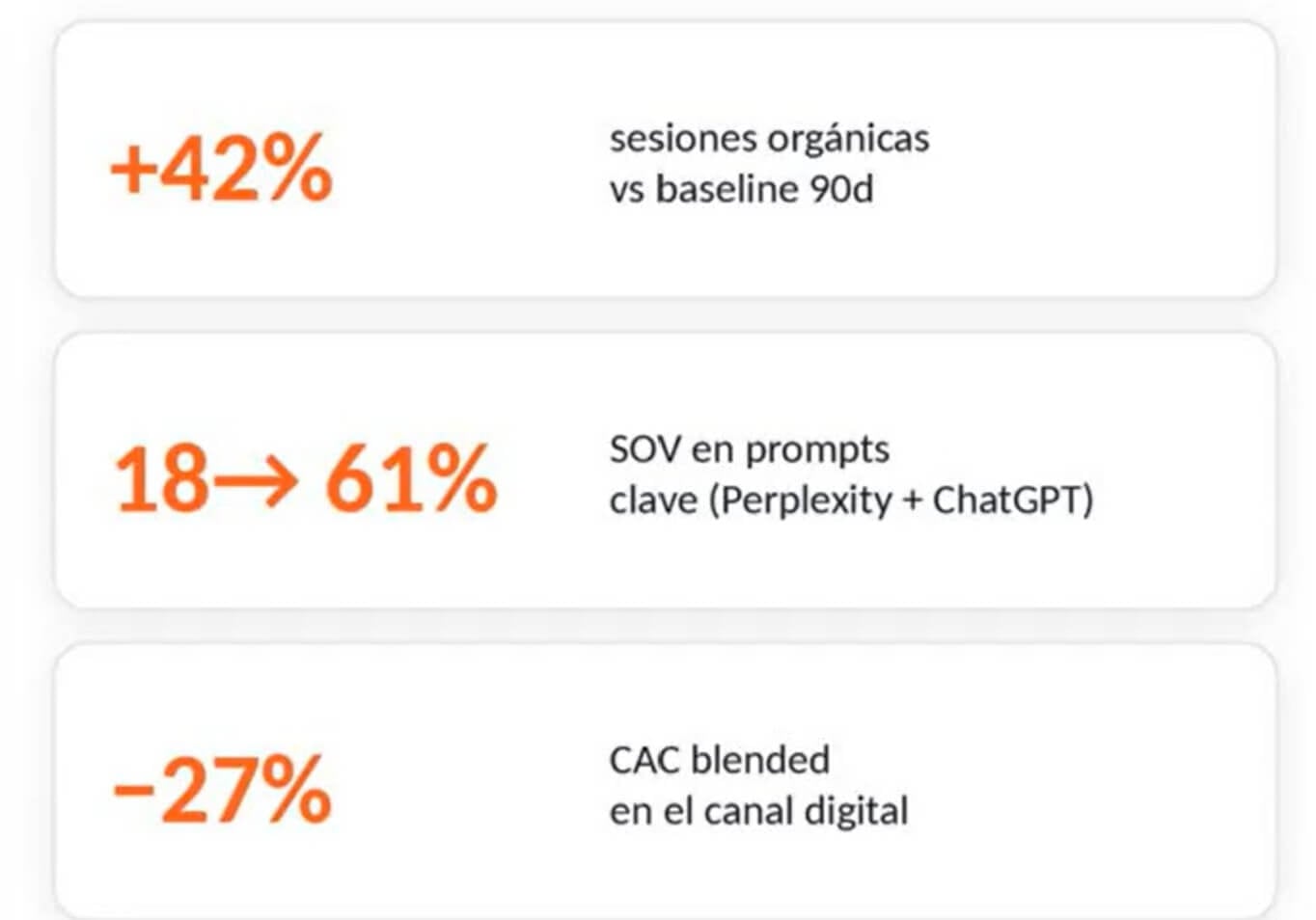
We see this pattern repeat itself across the accounts we manage: improved visibility within generative engines isn’t just an isolated marketing metric. It directly translates to lower customer acquisition costs, because a brand mentioned by AI requires less advertising to sustain the same volume of demand.
Want to see more results like this? You can check out other SEO, GEO, and AEO success stories we’ve worked on at Known Online.
How to Implement SEO, GEO, and AEO: The 30-, 60-, and 90-Day Plan
The roadmap we shared in the webinar is the same one we use as a starting point for our implementations:
- 30 days · Diagnosis: entity audit (schema, Wikipedia, directories), baseline for share of voice in LLMs based on 20 key prompts, and mapping of current content against the competition.
- 60 days · Foundations: complete schema, restructured “About” page, authors with verifiable bios, rewriting of 10 core pieces of content in a citable format, and a plan for media mentions across 3 vertical media outlets plus 2 podcasts.
- 90 days · Scale and measurement: a monthly-updated LLM share-of-voice dashboard, a proprietary dataset published under an open license, and a content program with a defined schedule and citation rate KPIs.
Organic traffic will continue to lose ground to AI-generated responses, and paid media will continue to put pressure on ROI as long as there is no visibility strategy beyond the click. The factor that sets a brand apart from its competitors today isn’t how much it spends on advertising, but whether it has built a recognizable brand, created shareable content, and established a measurement system that tracks what’s happening within ChatGPT, Perplexity, and Gemini.
This cannot be solved with a one-off SEO audit. It is solved by integrating entity management, content, off-page signals, and measurement into a single system, with proprietary data to support each step.
At Known Online, we implement this framework directly on your stack: entity and schema audits, content rewriting in a citable format, an off-page signals plan, and an LLM share-of-voice dashboard connected to your analytics.
If your brand still doesn’t know how many times it appears this month in generative AI, now is the time to find out.
Contact Known Online to implement your SEO, GEO, and AEO strategy.