


Two steps to bring customers back without having to pay for them again: activate the 7 core workflows with predictive analytics and integrate the CRM into your advertising strategy. Automated emails account for 2% of an e-commerce business’s email sends, but they generate 30% of all email revenue. Each automated email generates 16 times more revenue than a scheduled campaign because it reaches the recipient at the moment of intent (Omnisend, 2026 E-commerce Marketing Report, data from 150,000 brands). Based on that data, Ariel Bortz, Chief Operating Officer of Known Online, kicked off our webinar “More sales. More profitability. Less waste“The Recurrence Block: How to Work on the marketing automation for e-commerce, so that the customer comes back without you having to pay for them again.
Marketing Automation for E-commerce: The Right Message at the Moment of Intent
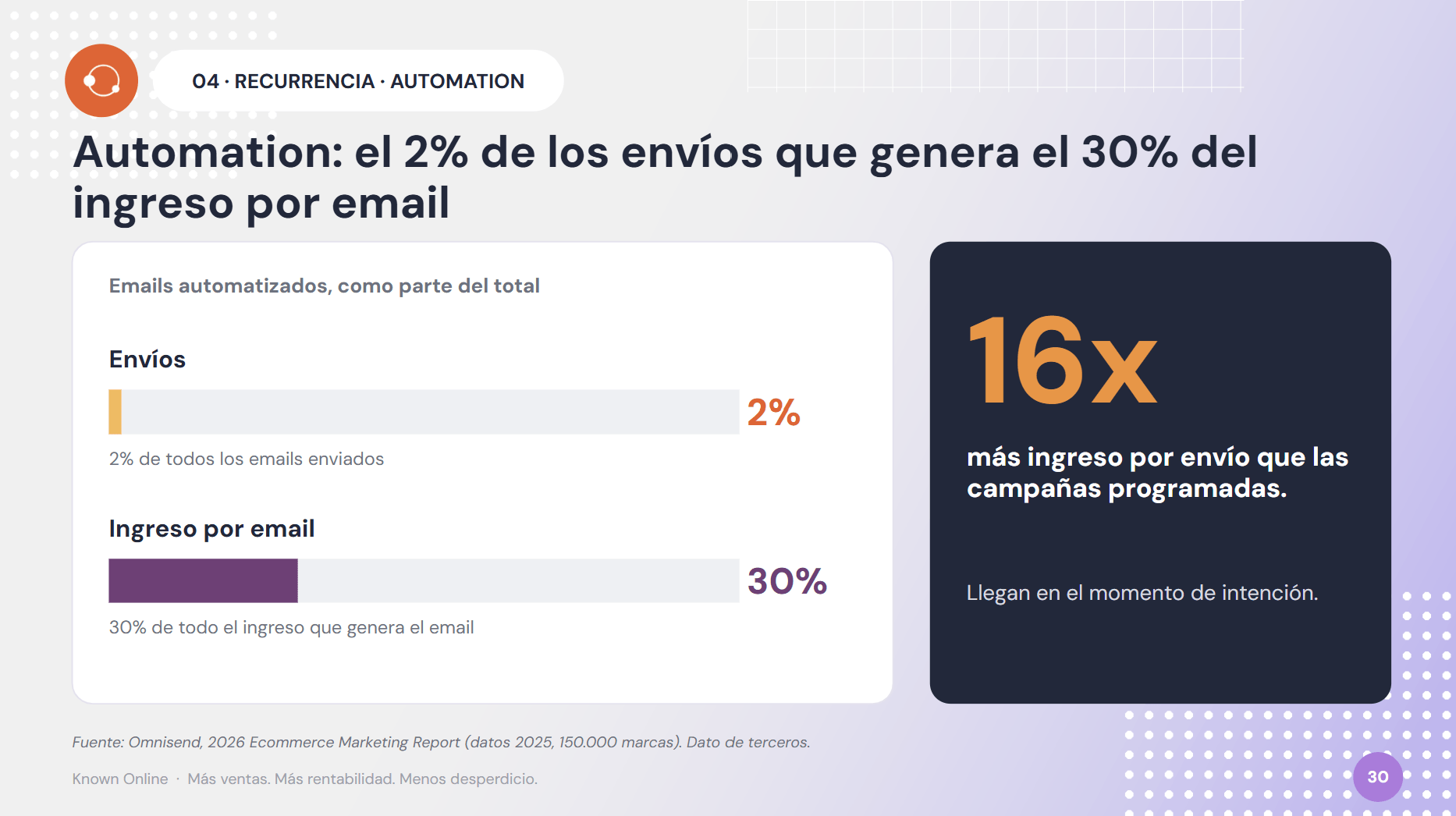
A message is effective when it arrives at the moment the customer intends to make a purchase. This applies to email, but also to WhatsApp or any other channel for communicating with customers.
Quick Win 01 · The 7 Core Workflows, with Prediction
Moderate effort · Very high impact
- Start with the welcome message and the abandoned cart.
- Add post-purchase, repeat purchases, and stock returns.
- Finish with abandoned navigation and reactivation.
If you don’t have all seven flows up and running, you’re missing something. The AI predicts the next purchase and chooses the most appropriate channel—email or WhatsApp.
In addition to these channels, there’s on-site personalization, which is one of our most important features today. There’s also ChatFlow AI, a sales assistant that guides users as they browse the site rather than simply answering questions. The metric is the percentage of revenue generated by these flows.
Quick Win 02 · From CRM to Advertising Campaign
Medium effort · High impact
- Use high-LTV customers as a seed audience.
- Use recent buyers as an exclusion.
- Separate new customers from repeat customers in the bid.
Connected to Google and Meta, the CRM generates predictive segments that update automatically. We implement this using Known CRM, which is integrated with these platforms, and the key metric is the customer acquisition cost (CAC) for new customers. This approach applies to e-commerce, lead generation, and both B2B and B2C marketing.
Stop optimizing individual channels: connect your data
- ERP or OMS: Inventory and margin drive the feed and bids.
- CRM: Buyers and their LTV drive audiences.
- Site Search: What people search for fuels SEO and keywords.
- Customer Service and WhatsApp: Customer objections fuel CRO and creative content.
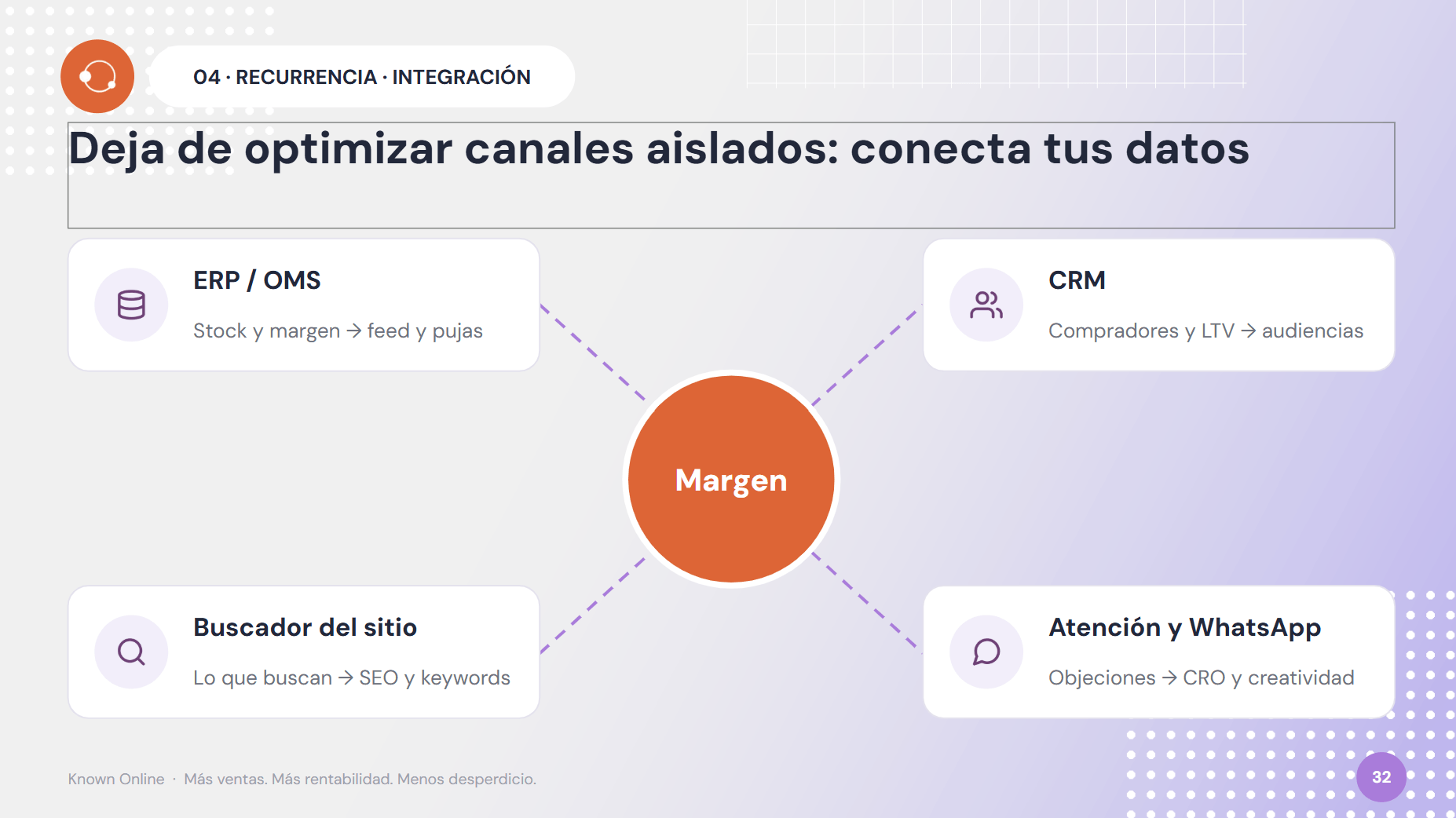
With the data connected, the margin becomes the common metric that is measured and sent to all platforms.
The webinar recording is available here.
At Known Online, we implement marketing automation for e-commerce, with predictive workflows via email and WhatsApp and a CRM integrated with the ad campaign.
The cheapest customer to acquire is the one who has already bought from you.
Frequently Asked Questions About Marketing Automation for E-commerce
What are the 7 core workflows of marketing automation?
Welcome, abandoned cart, post-purchase, repeat purchase, restock, abandoned browsing, and reactivation.
Is it better to use email or WhatsApp?
It depends on each customer. AI predicts the best channel based on their behavior; the workflows can run on both.
How is CRM used in advertising campaigns?
High-LTV customers serve as the seed for audiences, recent buyers are excluded, and new customers are separated from repeat customers in the bidding process. Connected to Google and Meta, the CRM generates predictive segments that update automatically.